Showing posts with label Geoffrey Rush. Show all posts

Wednesday, September 19, 2012

Discovering 'Nemo'


For the umpteen-millionth time; no, I'd never seen Finding Nemo before this past weekend. An early Pixar entry, Nemo was released well before my forays into animated movies. That's what makes Disney's recent trend of translating their animated titles to 3D for big screen release such a nice opportunity. They have already released The Lion King and Beauty and the Beast in 3D, and now that they're focusing on the more advanced animated pictures, I'll have the chance to not only see movies like Nemo that people are now constantly telling me are good, but also to see them on the big screen, the medium for which they were designed. I've already seen Monsters Inc in the theater, so I think I'll skip that particular conversion, but I'd love to go to the movies to see Ratatouille for the first time, and I'd gladly watch Wall-E, The Incredibles, and Up again were they to get the same treatment.

For those like me who have yet to see this, Finding Nemo follows young Nemo (Alexander Gould) and his overprotective father Marlin (Albert Brooks), two clownfish living in the great oceans. When Nemo is captured by humans and taken far away, Marlin searches the ocean for this son, helped by an absent-minded Pacific Blue Regal Tang named Dory (Ellen Degeneres) and a whole ocean of unique life. Meanwhile, Nemo finds himself in a dentist's office fish tank, alongside a number of other domesticated fish, and joins their leader Gil (Willem Dafoe) in their attempts to escape back into the ocean.

There's a whole ocean of life to explore.
I'm not sure what impresses me more; Finding Nemo's wonderful father/son story, or the fact that Pixar's method of mature storytelling has remained especially potent after all this time. Pixar tends not to treat the children who watch their movies like idiots, a saving grace when you consider how much Dreamworks tends to dumb down their content for mass consumption. In allowing mature themes (like the death of a spouse or the kidnapping of a child) to be the backbone of their animated features, Pixar makes their films so that both children and adults can appreciate. It really feels as though the studio puts as much effort into telling a film's story as it does making sure the animation is the absolute best, and that makes all the difference in the world. And their stories are so timeless that, should I have children of my own some day, I would gladly raise them on Pixar's animated movies.

"Mine?"
The animation studio has created a world undersea that feels absolutely ALIVE, and the creatures that inhabit it have a wide range of characteristics that play extremely well. Working with a wide variety of sources, director Andrew Stanton and his crew took pains to make sure every detail of the species they were committing to the big screen was accurate, while still making their characters unique and indistinguishable from one another. My personal favorites were the trio of sharks who had sworn off of eating their fellow sea creatures ("Fish are friends, not food"), but there are no weak characters for the entirety of the film. The voice cast finishes up by providing their usual excellence, with a cast that includes Brooks, DaFoe, Geoffrey Rush, Allison Janney and even Stanton himself in key roles. Degeneres however is a stand-out that really makes your heart tug. As an actress, she manages to take what could have been a one-note annoyance in Dory and make her performance absolutely heart-felt and essential to the story. There's a reason Degeneres became the first and only performer to win a Saturn award for a voice-only job, and seeing this I'm surprised she hasn't been approached for more roles in animated features.

"Stick with me, kid and you'll go places. Out the window, if you're lucky."

Of course, sometimes I have to remind myself that this movie DID come out in 2003, when computer-animated films were practically still in their infancy. While Stanton and his artists did a wonderful job animating the dozens of different animals that inhabit the world in and around the ocean, this was still a time when human animations were not quite at the same level. Additionally, one scene at the beginning that features a speeding boat at a distance feels extremely inferior to the otherwise-excellent animation. On the 3D side, it's actually surprising how little you notice the 3D elements once the film gets underway. There are some instances where you specifically notice pop, but more often the technology simply allows the viewer to melt into the oceanic landscape, rather than marvel at things coming out of the screen. That's a success, in my book, and well worth the extra ticket price to see it at the theater.

You'd better hope fish remain friends...
While it might not be quite as perfect as many of Pixar's more recent offerings, Finding Nemo manages tell a lively story, and sets it in a place as alien to many of its viewers as the vast reaches of space. And yet the animators still managed to make the whole thing feel absolutely human, exploring the father/son relationship in a way that is smart, heartbreaking, and oftentimes quite funny. It's easy to see how Pixar could go from this to some of their more recent creations. I still have a number of animated films from the last year on which to catch up, but I'm very, VERY happy I saw this on the big screen. If you have also successfully avoided seeing this before now, I encourage you to get out there and take the opportunity to see it in 3D while you can. I can't wait to see what Pixar does next, whether it be something brand new or a rehashing of the old. At this point, they can do little wrong by me.

Monday, May 23, 2011

Theme Ride Retread

2011 might be remembered as the year of the Hollywood sequel. In January, it was announced that 27 film sequels were scheduled for release during this year, and many of them not the first continuations of their franchises. While nine titles were the first attempts to continue series such as Pixar's Cars 2 and the live-action The Hangover Part II, many more are even further along film-wise, with Harry Potter and the Deathly Hallows Part 2 being the eighth addition to the series. As for fourth-film sequels, 2011 will have featured the greatest number of franchises that have lasted until the fourth release, including additions to the Mission: Impossible, Scream and Spy Kids sagas. For most of these releases, it is a sign from the powers that be that they can't (or won't) take chances when it comes to business as usual, so the sequel seems the way to go for guaranteed positive business. Most notable in that vein may be Pirates of the Caribbean: On Stranger Tides, the latest offering from the series based on the Disney park theme ride of the same name. When the original Pirates was released back in 2003, it made a legitimate blockbuster star out of Johnny Depp and his legendary character of Captain Jack Sparrow, and the film's financial success guaranteed that there would be much more to come. The first two sequels, Dead Man's Chest and At World's End, were disappointing to many critics and fans, but still sold out theaters and made gobs of dough for their efforts. Hence this attempt to rejuvenate the franchise with new characters, a new director (Rob Marshall), and otherwise the same old crew of miscreants, scallywags and swashbucklers appearing for your hard-earned dollar. For the last few months, I was convinced that this newest addition (supposedly the first of a new trilogy) would be either the best or the worst the series had to offer. By the time the final credits rolled, I was somewhat surprised by the results.

And THAT'S where the rum has gone!
Some time after the events of At World's End, Captain Jack Sparrow (Depp) finds himself in London. There, he searches for an impostor who is hiring a crew under his own name, supposedly on the hunt for the legendary Fountain of Youth. Discovering the impostors, Sparrow finds himself an important cog in a race to the location of the fountain, as three major forces move in for the prey: the powerful Spanish Armada, a British privateer ship captained by none other than Sparrow's rival Hector Barbossa (Geoffrey Rush), and a pirate ship captained by one of the most prolific legends of all time, Blackbeard himself (Ian McShane) and his daughter and Jack's former lover Angelica (Penelope Cruz).

"Carriage Surfing" was all the rage in London back then. Go ahead, put that in your term paper.
For one, I was quite happy for the change of characters in On Stranger Tides. While Sparrow and Barbossa are back, I was relieved when I learned that Keira Knightly and Orlando Bloom would not be returning as fated lovers Elizabeth and William, since their characters had run the course (and yes, I'm aware that the actors opted out for that same reason, you don't need to tell me). Instead, Marshall's plan implemented a more original route than his predecessor Gore Verbinski, who became so engrossed in the universe he had created he forgot that he was supposed to be making entertainment. Marshall's fresh eyes (as well as inspiration from Tim Powers' classic pirate novel On Stranger Tides) help to almost reboot the series while still remaining faithful to the original material. Intact is Jack's atypical sense of wit and logic, Jerry Bruckheimer's action-oriented strand of narrative, and the twisted bits of pirate lore and history that engulf the series's background. Sure, you could see a much more historically-accurate portrayal of life at sea in 2003's underrated Master and Commander, but that's never really been what Pirates was about. While it might pick and jab at historical iconography, the original trilogy reveled in silliness and good humor, while never backing away from the real and imaginary dangers of the world at that time. It reminds me so much of another swashbuckling adventure series, the Monkey Island games for the PC, of which the films have often been implied or accused of having copied.

Iam McShane warns Depp of the dangers of typecasting.
It's really a shame then that a film with so many things I love felt so disjointed. On Stranger Tides feels almost like a second cousin to its grandiose forebears, as even the effects-heavy bits don't stand up in scale to even those of the lesser Pirates sequels. Of course, that is no moon; one of the original trilogy's problems was Bruckheimer's overly-leaden special effects were merely cover for inane plots and plain silliness that didn't benefit the film at all. By scaling down the SFX here (even while incorporating the unnecessary 3D), the story is forced out into the open, allowing the screenwriters to flesh it out a bit more to modern standards. It isn't enough; the plot is very linear and uncompromising, with promising sub-stories either jarringly off the track or ignored altogether. While some genius exists (for instance seeing Jack's brain working out an escape plan in an early scene) the vast majority of the film is merely okay, generic pirate stories masquerading as an equal to The Iliad or The Odyssey.

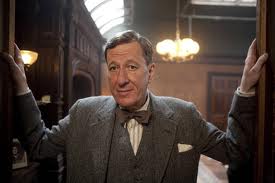
In other news, Geoffrey Rush tries on a new hat!
Jack Sparrow himself is also dangerously overexposed as a character; while Depp never makes any obvious miscues, Sparrow doesn't have nearly as much of the strong support needed to thrive as a leading star. While I don't miss Will and Elizabeth, I do miss the way their normalized manners grounded Sparrow as a character, not allowing himself to get too carried away; here, he's a free bird, and this bird you cannot change. Depp still does an amazing job delving into the role of Jack Sparrow, I just wish he could have had someone to play off him better. That job COULD have belonged to Penelope Cruz, but despite the amazing chemistry that develops between Depp's deranged charmer and Cruz's sharp-tongued schemer, they simply don't spend enough time together to make it fulfilling. Worse, Angelica transforms from bad-ass femme fatale  to devoted daddy's girl to vengeful psychotic, much to the chagrin of The Opinioness, I'm sure. Ian McShane is the best, no surprise to any who have witnessed his starring turn on HBO's Deadwood. The veteran actor perfectly takes over from previous villains Rush and Bill Nighy emulating one of history's most notorious pirate lords. Edward "Blackbeard" Teach has a reputation for ruthlessness and cruelty (which history may dispute but hey, it makes a good story) and McShane brings it out brilliantly. His voice also emulates that of Monkey Island's Ghost Pirate LeChuck, so he's got that going for him too (okay, no more M.I. asides, I assure you). Geoffrey Rush returns once more, but despite his not-inconsiderable talent, the character of the pirate Barbossa has pretty much run its course, and should have been retired after At World's End. Sam Claflin and Astrid Berges-Frisbey have little to do, and their story is sadly off-kilter with the rest of the film. Claflin plays a missionary who Angelica obtains to try and save her father's soul, while Berges-Frisbey is a mermaid who the crew needs to find the Fountain of Youth. Like Will and Elizabeth, the two have a romance that defies expectations, but because the characters aren't very well developed and the side-plot all but ignored by the script until it matters, both are relegated to the largely-silent background.

"And just like that... the rum was gone again."
I suppose expecting that Pirates of the Caribbean: On Stranger Tides could top Curse of the Black Pearl for top Pirates movie might have been a little ambitious. Curse was a wonderful fantasy story in a setting that hadn't seen any film popularity in years, and what it succeeded in was more than could be hoped for in ANY sequel. Still, On Stranger Tides does what only a Pirates movie can do best: disarm you with witty humor before the epic sword fight or sea battle keeps you on the edge of your seat. As a franchise film, it's better than either of Verbinski's attempts, and as a sequel it's better than Scream 4 but not as good as Fast Five. Far from masterful but still a lot of fun, On Stranger Tides is one good director and one great screenplay away from rekindling the magic that was the franchise's origins.

Friday, December 24, 2010

Or: The Trials of Mad King George the Stammerer

This past summer, I thought I wouldn't see a better trailer for a film in 2010 than those for Scott Pilgrim vs. the World, the comic-based film starring Michael Cera that I had been sure would be my number one film for the year. Sadly, the film did not live up to the standard set by Bryan O'Malley's comic series and while I still loved the film, one check of 2010's Top 10 films shows it not to have made the cut. Such is the danger of overly relying on a film's trailer to be an indicator of sed film's overall quality, and I learned my lesson from that experience not to set my expectations too high, lest I be disappointed again. Of course, Black Swan also had an excellent trailer and actually lived up to the hype, so it can be done. My favorite recent trailer, however, was for a film so completely unlike the two that though it has long been hailed by critics as one of the year's best, I wasn't sure if I would even have interest in seeing it. Of course, I did see The King's Speech yesterday, and now the only problem I have may be deciding where it falls in my Top 10.

Well of course he's having trouble: Who wouldn't in that hat?
The basis for the film comes from the true story of England's King George VI. While still serving as the Duke of York, Prince Albert (Colin Firth) begins to see speech therapist Lionel Logue (Geoffrey Rush) due to a pronounced stammer that made him terrified of public speaking, The creation of the "wireless" or radio means that the days of a member of the royal family simple being seen well not falling off his horse are over, and the King and his family are now expected to speak to their people through the airwaves. What culminates is a friendship between the future King of England and a commoner that is so unbelievable it must be true.

Don't you just want to buy him a drink?
Directed by noted British director Tom Hooper, The King's Speech is a film that lives and dies by its actors. Firth really pulls off the idea that he's a man with a serious verbal handicap, his speech impediment fully believable in its severity and adjustment throughout the film. The role of the future King George may not be as deep or as subtle as that of George Falconer from last year's excellent A Single Man, but that role was so amazing that to compare most any performance to it would be unfair, even for Firth. Still, Firth is an amazing presence on the screen, accurately and charismatically portraying one of the more famous nobles of the 20'th century with distinction. Rush is equally charming as the speech therapist Logue, whose treatment of the king involved some peculiar methods but mostly emphasized humor, patience and sympathy. Rush is disarmingly funny, but it would be wrong to simply call him a comedian and leave it at that. Logue is instead a strong character in his own right, driven by a need to help others that is admirable, especially in his charging expensive rates for his more affluent clients to cover care for those who can't afford his treatment. Rush is simply amazing, on par with Firth and better than any role I've ever seen him perform. Helena Bonham Carter is a surprise, as the woman who usually plays dark ladies in Tim Burton films proves she still can perform at a high level as the future Queen Elizabeth I. Carter plays both a loving wife and mother and a traditional monarch, and the blend makes for one of her best ever characters. Guy Pearce plays George's brother and predecessor, King Edward VIII, who so obviously doesn't want anything to do with the throne it almost makes you wince. Pearce has taken a step back from high-profile roles in recent years, but this minor role here is a good fit, and he manages to encompass in Edward everything that George has not, including confidence and excessive charm. The only real disappointment in the cast is Timothy Spall, whose attempt at a Winston Churchill impression works to some degree in the voice but looks like a scowling bulldog. For such a well-known historical figure, it would have been nice to get a more suitable actor for the role, as my eyebrows instinctively scrunched up every time he appeared on screen. Smaller roles my Michael Gambon, Derek Jacobi, Eve Best and Jennifer Ehle successfully round out a talented cast that do a good job of looking like they fit the times.

Tattoos are just more efficient for note-taking
The sets and camera work is fantastic, with several amazing camera shots of scenes throughout England. Hooper definitely has an eye towards detail, deftly changing angles to best suit the mood he wants to evoke from the audience. The best use of this is when we see through George's eyes, especially in large crowds when he's expected to speak, and we can understand his hesitation and fear to do so. There's also a very old-timey feel to the film quality that makes it feel like a classic period piece while being wholly realistic in its implementation.

Will Firth (or any of the others) get top awards for their performances?
In the end, it was really down to whether to place this highly-renowned film atop my year's Top 10 List. There was little worry going in to see it  that it would rank highly among this year's releases, and reason enough to think it may come out number one. But the idea of the "buddy comedy" comes to mind as I write these words. In your standard buddy film, two characters or completely differing backgrounds coming together for a common cause, and while their differences make for some funny moments for the audience, they eventually come together as friends by the story's conclusion. That fits The King's Speech to a tee... but it also describes about half of Jackie Chan's American films. That I'm comparing Rush Hour to this great film may seem like a slight, I assure you it's not. I simply mean that the story is somewhat formulaic in it's telling, and while it's based on a true story and has outstanding acting, it still drops it slightly in my book. Besides, for a film with such amazing performances, stellar dialogue and beautiful camerawork, landing at #2 for the year isn't a bad deal in the slightest.

Friday, December 10, 2010

Ninjas... Damn

Okay, having to wait for the good stuff to come out gets a little desperate sometimes. Deciding to go see a film in the theaters and then having to choose between The Warrior's Way and Faster just doesn't seem right somehow. The former is the premier film by writer/director Sngmoo Lee about a ninja assassin hiding out in an old west town, the latter another action film starring Dwayne Johnson and Billy Bob Thornton, who seemingly became persona non grata in Hollywood following his breakup from Angelina Jolie. And so, deciding that the first at least seemed somewhat original, I decided to haul myself across frozen rivers in hopes that I wasn't wasting my time.

Really, does sword-slashing really ever get old?
Despite what you might at first think, The Warrior's Way is not a martial arts film. Not really. Beginning perhaps with the multiple-award winning film I'm sure most have seen, Crouching Tiger Hidden Dragon, many Asian films that have made their way over the States have been over-the-top theatrical fantasy dramas, complete with impossible visuals and high-wire acts. In the early days of martial arts films, the story mainly evolved around people beating one another up, but what was so amazing about it was that the stars were their own stunt men, and many of the tricks pulled off were done solely by the performer, with little in the way of Hollywood trickery to make things appear more amazing than they really were. It simply wasn't needed. Now, while films like Ong Bak still portray martial artists as the ultimate stuntmen, many of the films coming overseas would kill to be the next Crouching Tiger or Jet Li's Hero, but the schtick is overdone now. While some, like Shaolin Soccer or Kung Fu Hustle have been better and done well overall, eventually you get to the point where you have to scream "Enough already!". Of course, The Warrior's Way isn't even an Asian-produced film. It was made in Auckland, New Zealand and funded by Barrie Osborne, who produced the Lord of the Rings films. So it's not really a martial arts movie. It's not even originally produced anywhere in Asia. It's about 90% English spoken, and has ridiculous visuals on top to boot. Oh boy, this should be fun.

Two of the biggest reasons not to see this movie
The film introduces us to Yang (Korean star Jang Dong-gun), the strongest assassin and greatest swordsman in the known world. Yang is a bad-ass cold-blooded killer with AWESOME flowing locks, tasked with the mission of killing every member of a rival clan. He's finally gotten to the end, his final enemy, killed their bodyguards, and just earned his new rep as greatest swordsman, but when his final target, a baby, inadvertently giggles, Yang has a change of heart, and decides to leave his homeland with the baby and search out an old friend who has immigrated to the USA's old west. And so Yang is hunted by his former clan, only to find that the town his friend has relocated to isn't much better.

Prepare for a fight-scene letdown
Early on, the real star of this film is the baby. Continuing what has become a new trend in Hollywood, The Warrior's Way has a baby that half the time steals the scene she happens to be in. In one scene, Yang kills an assassin who had attempted to get him to drop his guard. No sooner has the body hit the floor than the baby turns her head and gives Yang a look of "WTF!" Perfect. In these early scenes, seeing the baby do little things like this, or even watching Yang carry the baby by the scruff of its collar is amusing in it's own way. The child simply seemed to display the perfect attitude towards each scene, making the film to this point feel more authentic. Unfortunately, this is only for the first third of the film. After that, for whatever reason, the baby becomes much less important as secondary characters take more time away from young April. It's too bad, as from these early experiences I had hoped the film would have a story akin to that of the classic manga Lone Wolf and Cub.

Maybe they should have done this BEFORE she was cast
It's these secondary characters who make the film drag and feel somewhat less of what could have been. Geoffrey Rush is very good and at first almost unrecognizable as the town drunk, Ron. Good for a laugh at the beginning, Rush uses his ability to chew his way though any amount of scenery to make the most of his appearance here. And later, when he's required to be a bit more serious, he steps up to that plate as well. In short, Rush did amazing work to whatever was asked of him. The same cannot be said for Kate Bosworth as Lynne, a knife thrower with a tragic past. Even if I could get past the fact that Lynne was an uninteresting character to begin with, and that Bosworth's energy and spunk get tiring five minutes after we meet her, I simply can't get past the accent. For some reason she adopted what sounded to me to be an Alabama accent (For the old west? Really?), and the effect is annoying, atrocious, asinine, and that's just covering the A's. That she's out-acted by the baby (Analin Rudd) is telling. Tony Cox plays the mayor of this town of broken people - settlers who used to run a traveling circus - and for those who have pleasant memories of his role as the diminutive bad-guy in Bad Santa, good news! His performance level hasn't changed since 2003. At least Danny Huston is somewhat interesting as the evil character known as "The Colonel", a Civil War vet (I assume from the uniform) with a Phantom of the Opera vibe going who raids the small town with his army of brigands and pretty much has his way with the people and locale. Huston conveys evil well here, making him a compelling villain. Less so is Hong Kong actor Ti Lung as the master of Yang's former clan, who eventually hunts his former student down. This isn't really because of Lung's performance, though performing in English rather than an Asian dialect does make the film seem like it's truly geared towards the cinema buff who can't be bothered to read subtitles. Frankly, not enough is done with the part, even through a few flashbacks, to convey why he's so evil in Yang's mind. Okay, except for the whole baby-killing thing.

You tell 'em, drunken Geoffrey Rush!
The best part is actually played by the film's lead (What a concept!). Dong-gun, whose films Friend and Taegukgi: The Brotherhood of War have shattered Korean box office records, is more than just good looks. He carries himself with a confidence that reminds me of a young Chow Yun-fat and his performance holds many subtleties that draw us in and keep us fixated on him. Silly special effects notwithstanding, we get the real idea of him as a character adjusting to his new, peaceful life, with not a little bit of culture shock and a few adjustments to be made. Like the baby, his best scenes are early on, and make me wish again the film had been more about the two of them on the road and avoided the whole remote town idea altogether.

This doesn't look better on screen, trust me
The visuals are at once pretty and distracting, as our eyes are drawn to the shiny and colorful backgrounds of overly-rendered green screen backdrops. The problem is that we're supposed to be paying attention to the people on the screen, and too often are the backgrounds far more interesting. Some, like the cherry blossoms blowing in the wind of the opening scene, are absolutely gorgeous, and it's a shame that the quality varies so much over the course of the film. I think I would have appreciated more gritty, less colorful views of the world, like those of this year's Book of Eli. The digital quality was somewhat lacking as well. The few explosions are pretty, but one scene involving the bad guys climbing a half-built Ferris wheel simply LOOKS like digitally-rendered characters climbing a digitally-rendered wheel. It looks cheap on the big screen, and probably should have undergone a few tweaks before it was added to the film reel. Fight scenes are mostly uninspired, with most action being quick, unseen, and unrealistic, partly the silliness of the genre, and partly because they didn't have an actual martial artist in the lead role.

Bringing a gun to a knife fight... such lack of class!
When we get down to it, The Warrior's Way is not a good movie. Some redeeming performances prevent it from being a BAD movie, but while it's probably been under-appreciated thus far, it's squarely in the middle and there just isn't much to recommend it.. Some script revisions wouldn't have hurt, as the story simply didn't work as is, and Bosworth was simply the wrong actress cast for her role. Part of me wanted to like this film, and I certainly don't regret seeing Dong-gun in action. I might check out the international section of the nearby rental shop and see if I can find any of his earlier works. But that's not enough to say you should see this film, especially now that with awards season underway, there are at least a half dozen other films you should be seeing instead.