Thursday, July 24, 2008

Detective Distress!

With this upcoming post, I had a conundrum: Which medium of the comics world was I ignoring more and had to correct; Independent web comics that were collected in print, or DC comics? As you see, I had to get some DC going on this site again, lest Dan Didio come down to my apartment and roast my Batarang over a slow-cook fire.

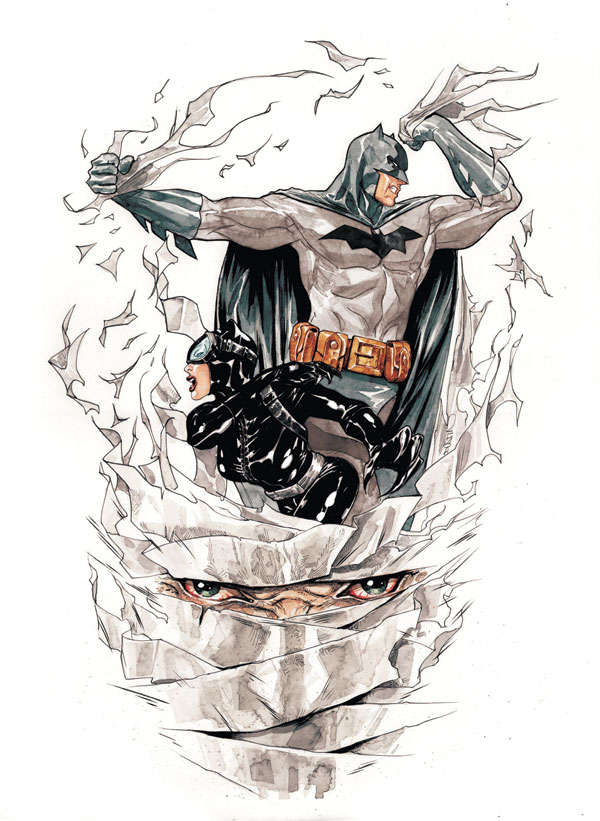
Detective Comics #846 features the return of Bruce Wayne's childhood friend Thomas Elliot, also known as the murderous Hush, forever bandaged and mentally disturbed. Hush has come back to town to once again attempt to get revenge on Wayne/Batman, in ways that will only unfurl in the coming issues.

For the time being, Batman is not alone. Catwoman is also in this issue, and figures to play a prominent part on the road ahead. They come across one another when Wayne (undercover as two-bit thug Lefty Knox) tries to take down a gang led by a fairy-tale-reciting Doctor Aesop. When he's cried "wolf" a few too many times, Wayne has to be rescued by Catwoman, who happens to be in the area. The two resolve to team up and take down Aesop together, at least until the next argument hits.

Much of the book tells the origin of Hush, who actually wanted the life of Bruce Wayne, but on his terms. Whereas Bruce's parents were killed by chance, Thomas had no such luck in his future, so he tampered with the brakes on his parents' limousine. Furious when Bruce's father saved the life of his mother, and further avoiding vengeance when Bruce's parents are not killed by his hand, Thomas truly and insanely hates Bruce Wayne for the life that he has, both as a magnate and as the superhero crime fighter.

What's left is his revenge to be wrought, and he makes himself known to the Batman in the end. There are many questions to be answered in the next four issues, not the least of which is how this evenly-matched opponent of Batman plans to succeed. There's nothing worse than a villain who knows you so entirely well that he can predict your every action, and Hush is that kind of bad guy.

The pen of Paul Dini (Countdown, Madame Mirage) more than makes this title worth reading. His extensive work with the character of Batman and his history of writing for the Batman TV shows (and the creation of such characters as Harley Quinn) are readily apparent in his writing. He knows perhaps more about the Dark Knight than anyone else in the industry (or at least has been so submerged with it that he just oozes Batman know-how) and his writing is fantastic, coherently telling a story good enough to eat. The dialogue is great, the pacing is wonderful, even the back story is solid, all without giving away too much for a first issue.

Sadly, the artwork doesn't live up to the writing talent. I'm sure Dustin Nguyen (Manifest Eternity, The Authority) must have talent. I'm just not sure it's with drawing comics. Not that his style doesn't suit Batman in any way, shape or form. His dark shadows and detailed backgrounds match Bats perfectly. It's just that the artwork is so darned sloppy! I hate looking at the art, and that's three quarters of why I'm reading in the first place!

Fortunately, Dini's writing is good enough to pass this otherwise-dud. Detective Comics retains it's luster and will hopefully keep my comic needs sated until the next big storyline comes along. Until then, arrivaderci!

Thursday, July 3, 2008

Wanted: Great Entertainment

The August issue of Details Magazine contains the following quote: "James McAvoy made out with Angelina Jolie, and you didn't." Frankly, I don't need Details to tell me that my fantasies haven't played out quite as expected, but the first trailer I saw of Wanted made me lean back and go "Whoa."

It was lust at first sight; all that violence; all that action; all that Angelina. Even the aforementioned McAvoy seemed to fit the part, and when you add a deep-voiced superstar like Morgan Freeman to the mix, you have a truly intriguing story, cast, and overall movie you just HAVE to watch.

Imagine to my surprise, then, that Wanted, directed by Timur Bekmambetov (Night Watch), was actually based on a miniseries written by Ultimates scribe Mark Millar and drawn by Alex Ross wannabe J.G. Jones (Final Crisis). Even more astounded now, I decided I had to see both, starting with the sure-to-be-fantastic movie.

One thing to remember with Wanted: The Movie is very much based in reality. Even the opening sequence, where we see man leap through a plate glass window out of a high-up office tower over to ANOTHER tower a few hundred yards away to eliminate his would-be assassins, you hardly feel like you've left the modern-day world. This is also true when you see people shoot bullets out of the air, curve bullets or do other fits of daring-do... normal people wouldn't be able to do these things, but our heroes can.

And that brings us to McAvoy, playing the role of Wesley Gibson. Wesley is like you or me. He hates his job. He hates that his best friend is fucking his girlfriend when his back is turned. He hates his father for abandoning him at eighteen weeks old. He hates his ergonomic keyboard. He takes medication for severe panic attacks. Okay, maybe not QUITE like you or me. Wesley is used to being pushed around. He's never been the assertive type, used to being stepped on and never sure how to stop it. Along comes Fox (Jolie) who tells him his father was killed in our opening scene not too long ago, and after a bit of wild driving, she brings him to the Fraternity, led by the great Freeman as Sloan, who would train Wesley to be good enough to kill the rebel assassin who killed his dad.

First of all, the action sequences are fantastic. The only real hiccup is the driving scene with Jolie and McAvoy being chased by the bad guy (King Kong's Thomas Kretschmann) in which the camera gets a little too close and obscures some of the action. Besides that, though, the movie's action scenes are flawless, constantly letting blood and bending the fabric of reality to make everything both believable and unbelievable at the same time. I always knew Jolie could act, and McAvoy is fantastic as both the sniveling worm he starts as and the hardened killer he becomes. Other strong performances include Kretschmann and Common, who plays one of Wesley's trainers. Sadly, it seems that Morgan Freeman mails in his performance, though it didn't hurt the movie any with him at only half-strength. There are also some scenes that are a little TOO out there (animal rights activists will have trouble with a couple of scenes, though a slight reminder that this is just a movie should alleviate those concerns) and ridiculous, but nothing that detracts from the final product.

In all, Wanted is a fantastic movie. It's got acting, action, mythology and just plain bad-assness, all the while rooting itself in the real world in a completely believable fashion. I highly recommend it to any who haven't watched it yet. And if you have, make definite plans to pick it up on DVD, which it probably will by this Christmas.

I wish there were an easier way to compare the movie and the graphic novel well. I definitely liked the book, but I LOVED the movie so much more. However, it's hardly an even playing field, as the two mediums are so different that their disparate traits outnumber their similarities by a wide margin.

First of all, the majority of the story takes place in New York City (in the movie, it was Chicago). It starts off the same though, with anger and violence ripping through the first few scenes before we even get to Wesley. It's obvious from the start that there are some issues that take place in the book that don't place in the movie (racism, gender degradation, homosexuality, even excess violence).

But probably the most pointed difference between the book and the movie is that in the book, the Brotherhood are in reality a league of super villains. (Note: That wasn't a spoiler, if you read the FIRST ISSUE you'll see I'm right; they lay it out up front) Years ago, they organized, teamed up on the population of super heroes, and killed all of them. Then they wiped the memories of these heroes from the minds of the populace and now they run the world like a black-curtained Illuminati. As a member of the Fraternity, you can destroy, kill, rape, and rob with impunity, never being blamed for your actions. And Wesley's in since his dad was The Killer, a super assassin who never missed. Obviously, this changes the whole scheme of the universe, but I still liked the movie's ability to ground in reality, while the books seems far-fetched and full of holes.

Jones definitely loves his celebrity faces, as the main characters in the story look like Eminem, Halle Berry and Tommy Lee Jones. His art is actually very good, though some flashback sequences are drawn by Dick Giordano (The Phantom) and don't work as well. Jones is definitely the superior artist, and the vulgar and violent undertones are done well here.

Disappointing though is Millar's writing, which doesn't adopt the redemption story in the movie and instead the message the book seems to be trying to get across is "Fuck the world". On top of that, uninspired characters (Sucker, Fuck-Wit and Shit-Head are some such villains who don't amount to crap) and a general plot malaise don't quite live up to the clever dialogue and occasionally hilarious one-liners. If this had been more like the movie's story, instead of ANOTHER super-hero story, it might have been a little more original and stood out from the acres upon acres of indie super stores that exist out there today.

I picked up the Assassin's Edition of the Wanted novel, which includes some fantastic concept art, storyboards, covers, character dossiers and creator interviews. These are almost worth the price of admission alone, but I guess it depends on how much you like extras.

So there you have it! For once, the movie is BETTER than the book! Who'd a' thunk it? I hope you enjoyed this review, we're looking forward to the next Latest Issue!

Tuesday, May 20, 2008

Nighttime Readings...

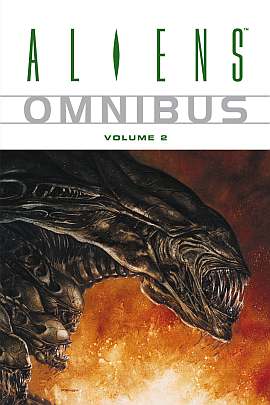
Does anyone these days even pay attention to the Alien franchise anymore? After Jean-Paul Jeunet successfully ran the franchise into the ground in 1997, two Predator crossovers have yet to revive the popularity of what might be one of the scariest movie monsters ever conceived. Fortunately, it seems redemption is on the horizon. Dark Horse Books has not only begun releasing new novels based on the Aliens universe (and bringing in top-selling authors such as Diane Carey, John Shirley, and S.D. Perry, to boot), but have also begun to re-release their archives of Aliens comic books - some never before collected - in their new Omnibus series of books.

Back in the nineties, it seemed like Dark Horse just might challenge for an upper echelon spot among the Marvel and DC titles dotting the landscape. With unique titles such as Hellboy, Ghost, and The Mask, and with license agreements for Predator, Star Wars, Terminator, and Tarzan, there seemed no stopping what has since become one of the largest independent comic companies in the United States. And the Aliens license was right there, with multiple series exploring more and more about not only the Aliens universe, but also the basic functionality of how the "bugs" tick. What drives them? This was the overlying question many comic writers asked themselves when they compiled these books.

When I first glimpsed the Omnibus series, I have to admit; I was intrigued. Though I owned a number of the collected trades already (my copies of Rogue and Genocide are worn to shambles by now) I was interested to see what was included in these collections, if they were as complete as they could be.

Oh, boy, were they.

I picked up Aliens Omnibus: Volume 2 and was immediately awestruck when I opened to the table of contents and read the third title listed: Aliens: Colonial Marines. The first issue of Colonial Marines had been printed in January of 1993, and I'd had a chance to read my cousin's copy of issues 1 and 2. Eager to read the rest, I searched comic shops all over Boston... without luck at all. I so desperately wanted to finish the story, but had no means to do so, and by the time the Internet came around, I'd completely forgotten my longing to complete the series. Now I had it in front of me, never before collected, and just waiting for me to plunk down my $24.95 (plus tax) to read it en masse. I was ready.

But there were two other stories included as well, both brimming with promise, and, good reviewer I am, I'll review all three in this special edition of The Latest Issue.

In the first story, Aliens: Genocide, Earth is in a delicate time. The planet is just recovering from an invasion of acid-blooded, face-chomping, bug-like aliens, and Everyone is doing their part to help the world recover. Of those people is multi-billionaire and all-around grease ball Daniel Grant, CEO of the Grant Corporation, one of the strongest companies to emerge from the post-war ashes to help rebuild the world. Grant isn't truly an evil sort, but he's definitely one who expects things to go without a hitch, so he's understandably upset when his company's new wonder-drug, Xeno-Zip - derived from the medical breakthroughs discovered from studying the alien biology - triggers something of an abnormal reaction in a small percentage of people, creating berserkers and hyper speed-freaks. This reaction is due to a synthetic element in the drug, created to mimic something that can't be found on Earth: An alien Queen's Royal Jelly.

Naturally, the army loves Xeno-Zip, side effects and all, so Grant strikes a deal with them: Help me get Royal Jelly from the Alien home planet to perfect my commercial formula, and I'll supply the army with an unlimited supply of the "flawed" drug. This introduces Major Alex Lee, the youngest holder of the Congressional Medal of Honor and an honorable soldier who fully questions the need for this mission to exist. Add in a hidden saboteur who would like nothing more than to see Daniel Grant fail and an inter-species Alien war, and you've got a fairly compelling five-part story that doesn't skimp on the alien-human violence.

As one of the better written stories in the bunch, John Arcudi (The Mask, Gen 13) deserves a lot of credit. The story paces smoothly, with character development readily moving the story forward, as Grant becomes a more sympathetic character and the soldiers themselves gaining some face-time to grow. On top of that, the art is exceptionally consistent, with Damon Willis and Karl Story (Batman, Aliens vs. Predator) doing terrific work on pencils and inks, in that order, and my personal favorite Arthur Suydam (whose covers for Marvel Zombies, Black Panther, and Wolverine have lately been fantastic) bringing his unique color scheme to this title to complete an all-around good look that is consistent throughout all five issues. My only complaint with this story is the seeming lack of drawn-out battles with the alien species: with the exception of one shown battle, most of the fights are short and not-t00-sweet. We at the Latest issue like to know who's getting killed when, even if that character never uttered a word the entire time, as it was in the second Aliens movie.

We loved Rogue, though. It was a fair reminder of just how good Dark Horse can get when they bring in the right talent to get the job done. A plus mark for the first third of the book.

We wish we could say the same for Aliens: Harvest. It brings a unique idea to the table: Dr. Stan Mayakovsky builds an android replicate of an Alien with the intent of stealing into a hive and stealing Royal Jelly, which has become a precious commodity on the black market. Of course, Stan doesn't care about that, he just wants enough to stop the cancer that has ravaged his body, and let his partners do what they will with the rest.

To complete his task, Stan builds XL1, or Norbert; A synthetic alien design with advanced intelligence and one mission: infiltrate the alien hive, and commandeer the favored royal jelly (stop me if you've heard this before). XL1 certainly comes in handy when Mayakovsky and his team become stranded on the planet surface, facing hordes of alien legions.

With the exception of the alien android XL1, there really isn't anything about Harvest that stands out. The writing of Jerry Prosser (one of the co-creators of Dark Horse, The Crow) is mediocre at best, confoundedly difficult to understand at worst. I could forgive the equally awful artwork by Kelley Jones (Batman, Sandman) if the writing was a little better. At least the art was unique. I wish I could say more about this title, but honest to heart, I just wanted to get this bad part over with before I got to the part of the book I really wanted to see.

Aliens: Colonial Marines starts off great. A deep space waste-disposal facility is our first destination, as the crew not-so-merrily launches barrel after barrel of toxic waste into the local yellow star. It's the ass end of space, and the crew is trying to finish the current shipment before the local administrator for Alpha Tech stops by to supervise their work and drop off a replacement security detachment. Knowing this is coming, the crew is shocked and appalled when they observe a new ship, the Laing, coming in to make an unscheduled delivery. They never know until the last second that the Laing is home to a whole nest of Aliens, at least not until it's too late.

This brings us to USCM base Dover, where a young Lt. Joseph Henry is sitting in the brig, punishment for striking a superior officer. Henry has always been one to dismiss authority, probably caused by the precipitous relationship shared with his father, head of the Joint Services Committee, and one who was never around during Henry's youth. Henry learns he has been tabbed to run a platoon of untrainable goldbrick marines and take them to a hard labor station to try to work them into reasonable soldiers. Aided by no-nonsense Sergeant Nyland and gigantic synthetic Liston, Henry is also bringing administrator Beliveau and his hand-picked security team to that very waste disposal facility. This leads to a race against time to see who's manipulating the aliens and leads to some very frantic firefights. At least that's the idea.

The first three issues are great. Chris Warner (Barb Wire, Aliens vs. Predator) is very dialogue heavy, but once the action sets in, he's as good as any writer out there. And he's helped by the best part of the book, penciler Tony Akins (Heartbreakers, Star Wars: Tales of the Jedi) who by far does the best work in the entire book, with solid art and recognizable characters. It's a joy to read the first three chapters for his work alone.

However, that's when the honeymoon ends. I don't know if this crew were first signed to do the whole series, but after these issues Dark Horse made a change, with Kelley Puckett (Batgirl, Supergirl) taking over the script and Allen Nunis (X-Wing Rogue Squadron) doing the artwork. There's not much to say, but I will anyway: Bad dialogue, lousy and inconsistent artwork. They traded in Warner and Akins for these schlubs? Fortunately, Akins makes a quick one-time return to drawing in issue 7, and Dan Jolley (Obergeist, Firestorm) takes over writing duties in issue 9, to finish the series. Also, John Nadeau (X-Wing Rogue Squadron) begins in issue 8 to create images far superior to that of Nunis and even Akins. The last three issues in the series are by far the best, though they might have been better if not for the mediocrity that preceded them.

This series has troubles, doubt me not. First and foremost, while the truly main characters are fleshed out and humanized to great extents, many of the "grunts" who are portrayed here never are. Rake, Rosemas, Chen, Cvercko, Maryland, Beech, Bateman, Berganza, Carrano, Koo, Forsyth, Dinkel, Vormitag and Boston are all just names, not characters with pasts or stories to tell. Even potentially intriguing characters like Carmen Vazquez (little sister of the more famous Vazquez as portrayed in Aliens) are poorly used. They're all just backdrop. To top it off, it seems none of the artists really synced up with how any character was supposed to look; With the exception of the "minority" characters, none of the secondary people seem to differentiate from one another, resulting in confusing glances from the reader as to wonder who the hell's dialogue he just read. Top that off with Nunis' bad art, Puckett's bad writing, poor layouts and the apparent cutting of the series from twelve issues to ten (which might have solved some of the character problems) and you have a purely bellow-average scoring series that could have been much more.

I wish I loved this book more. Genocide was fantastic, Harvest was atrocious, and Colonial Marines was just so-so. Better and worse series have existed than these three, but for a barometer of what the Aliens franchise is capable of, check out this book.

Just don't pay full price.

Monday, February 4, 2008

Polar Opposites

Today I have a special treat. Since I haven't been around much, I'm presenting two reviews for the price of one! And since the price of one review costs nothing, it's the best deal you'll find online! Not only that, but I'm reviewing both major licenses today, as one of my reviews is from DC Comics, the other from their competitor Marvel Comics. Finally, topping all that, both titles are written by the top writers in both organizations, promising me an unparalleled level of enjoyment bringing these titles to you!

Our first review is of Green Lantern #27, written by one of my personal favorites Geoff Johns (52, Booster Gold) and penciled by Mike McKone (Teen Titans, Fantastic Four). It's an interesting time in for the Green Lantern Corps. The Sinestro War is over. It cost the lives of many Green Lanterns and caused the Guardians to enact ten new rules in the Book of Oa. First and foremost of those rules is the ability for Green Lanterns to use lethal force, the lack of which had seriously hurt the Lanterns for much of the Sinestro War. The processing plant that had created yellow power rings for the Sinestro Corps has been destroyed. But most of the new laws of the Book of Oa are still a mystery, and most Green Lanterns are tasked with tracking down the remaining Sinestro Corps rings that still search the cosmos looking for new owners.

That's how this issue opens, with Green Lanterns Hal Jordan and John Stewart being called in to retrieve a yellow ring inbound to Earth. Eventually the intergalactic policemen catch up to the ring before Jonathan "The Scarecrow" Crane can be properly recruited to the still-dangerous Sinestro Corps, but in checking, they find the ring belonged to Amon Sur, the son of the man who recruited Hal Jordan to the GL Corps in the first place.

We're then brought to a GL meeting room, where several Green Lanterns attempt to come to terms with something they've never had to before; GL Laira of sector 112 is accused of murdering Amon Sur, who had slaughtered the family of a fallen Green Lantern before attempting to surrender himself to the so-called "Lost Lanterns." Laira had responded by killing Amon Sur in a blind rage, having to be restrained by her teammates. It immediately brings into question the first new Law of Oa, which grants lethal force, but doesn't implicitly express when to use it. Eventually Jordan and Stewart arrive to question how this happened, when the Guardians appear. Not wanting to justify cold-blooded murder, the Guardians create the Alpha Lanterns, kind of an internal affairs organization within the Corps to police the police. Six Green Lanterns are chosen to represent the new Alpha Lanterns (including Lost Lantern Boodika, pictured above), with only John Stewart declining, choosing not to take part until he learns more about Oa's new laws.

There's not a whole lot of action in this book, being mostly a talkie about the morality of murdering a murderer, and introducing the new Alpha Lanterns. But it's a talkie done well, as Geoff Johns expertly creates dialog between the conflicting Green Lanterns and the Guardians. Major changes would appear to be in store for this title (and it's sister title, Green Lantern Corps) and I wouldn't trust it better in any other writer's hands. McKone's artwork is equally excellent. Most of the settings are in the Green Lantern headquarters, so most of the backgrounds are green with little hint to the specific rooms the characters inhabit, but the character artwork is excellent enough to make that critique a small quibble. McKone had a blast drawing all the Green Lanterns, and the scene of the power ring entering Arkham to find the Scarecrow is fantastically drawn. An excellent job all around on this title, one that I'm really getting into reading on a regular basis.

And here's another title I've been in love with of late. Written by Brian Michael Bendis (all the Avengers titles) and penciled by Carlo Pagulayan (Planet Hulk, Marvel Adventures Fantastic Four), New Avengers Annual #2 rectifies one of the biggest let-downs of this series. At the end of issue 37 of this series, The organization put together by Parker "The Hood" Robbins was dismantled and put away by the New Avengers. The Hood responds... by breaking into the prison his people are in and getting out every last one of them. What kind of anti-climactic bull is that? That issue left a bad taste in my mouth, that this team would go through all the trouble of rounding up these criminals (all of it while unregistered, mind you) just to have one unused villain undo all they did in one fell swoop.

On top of that, this team of New Avengers is probably the most mismatched team of heroes on the market right now. I like the use of Luke Cage, Iron Fist, Echo and Ronin (Clint Barton) on the team, and I love anything I see Stephen Strange in, but Spider-Man and Wolverine? They may be the most popular characters in the Marvel Universe right now (and probably for a long time after today) but Wolverine is a known mutant with the X-Men, and Spider-Man as he exists now woudn't really be part of this group anymore.

It makes for great team chemistry, however, as the group returns to the home of Stephen Strange from their latest mission successful. They're not uninjured however, as Dr. Strange must be taken to his room by his assistant Wong and his girlfriend the Night Nurse. The rest are just looking forward to a night without any more activity, without worrying about hoods or Skrulls or symbiotes. Too bad for them The Hood has gathered no less than twenty-five supervillains (including the Wrecking Crew, Madame Masque, The Wizard and Jigsaw) with the intent of storming Strange's home and destroying the New Avengers on their own turf, much like the Masters of Evil that did the same ten years ago.

What follows can only be described as an awesome battle royale of near-biblical proportions, as the villains pile up on the weary heroes. In essence, it's the complete opposite of Green Lantern, all action with little moral chatter or much dialogue at all. It's just a pile-on, one in which the heroes are hanging on by the tips of their fingers.

This issue is one of my favorites of Bendis'. He ties this annual deftly into the current Avengers story, and also including references to World War Hulk. He continues to be one of my favorite writers, even if it does seem like Marvel entrusts far too much of the universe's current storytelling solely to him. The Avengers' titles are his baby, though, and he's hardly made any missteps in their telling. And the twists he introduce at the end create a true cliffhanger, as the team will have to make some changes after this issue to continue to exist. Pagulayan does an unexpectedly fantastic job in this issue. Sometimes I think his art can get a little too gritty at times, but this issue is surprisingly clean, with colors blending perfectly with his pencilwork. Pagulayan probably has never had to draw this much action in a single issue, and he obviously reveled in the chance to create as much destruction as thirty-plus superpowered individuals could do in the span of thirty-six pages. Also, I liked the ad-cameo for Oceanic Airlines, as a Lost fan myself I have to smile at that little thing in there to identify with the comic creators on some level.

The verdict is in! We love both Marvel and DC titles! Both New Avengers and Green Lantern represent some of the best their companies have to offer, and we're always excited to see consistantly great work on the shelves for purchase. Read these with our blessings, you won't go wrong curling up with either of these titles on a cold New England evening.

Monday, January 7, 2008

A Return to Form in 2008!

It's never fun realizing you've been neglecting your responsibilities. The holidays, family and computer issues combined are just part of what's been happening to me the past few weeks, but I'm sorry to say a lack of posting on The Latest Issue can be squarely placed on my shoulders and all the other things happening in my life can be pretty much disregarded as just unwelcome distractions. I've tried several times since December 16 to get a new post written, from a summary review of the just-ended World War Hulk, to the new Legion of Super-heroes run with Jim Shooter at the helm, to a Stevereads and Moving Picture Trash-inspired Best and Worst of 2007. Sadly, all these attempts were scrapped before a single paragraph was completed, as my attentions were drawn elsewhere.

I like to write for the Latest Issue, and hate to think I've let down my loyal readers with my neglect and my own issues. So, with enough of my ramblings out of the way (don't you hate when people whine about their lives?) here it is, the first Latest Issue of 2008: Teen Titans, Year One.

Written by Amy Wolfram (in her first print book; She's better known as a writer on such animated series as Teen Titans, Legion of Superheroes, and Xiaolin Showdown) and with pencils by Karl Kerschl (Adventures of Superman, Flash), Titans is both a retelling and revamping of the Teen Titan's origins, as young proteges struggling to establish their identities apart from their mentors. Book one reintroduces us to four original members of the Teen Titans franchise: Robin, Kid Flash, Aqualad, and Wonder Girl.

One of the first things we notice about these characters is how they're properly portrayed as their namesakes suggest, larger than life super-humans, but teens all the same. When we first see Robin, he's deep in the Batcave, using the computer to try and find out information on a sneaky cat burglar who's been terrorizing Gotham (His screen name: BOYWONDER07) by contacting other young superheroes. Before he can get any answers, a particularly bad-ass Batman pulls him away from the computer to do what Batman's always done: patrol rooftops looking for anyone suspicious. It's somewhat a metaphor for the generational differences of the superhuman community ("In my day, superheroes went out to fight crime, they didn't sit in front of the fancy-dance computer all day first") and also sets some friction between the Dark Knight and the Boy Wonder not seen since George Clooney and Chris O'Donnell represented those roles (or was that the friction between the franchise and the movie-going public?).

This in turn leads us to Wally West, better known as Kid Flash. He answers Robin's chat message too late to catch Robin, and we get to see Attention Deficit Disorder at it's greatest level. This is a kid who will run to Paris just to get some streetcar french fries, and that just to pass a few seconds while he awaits for Robin to respond. Instant messaging is too slow for Wally, and this part of the issue is by far the best paced part of the story.

After the Kid Flash intro, we're out-of-the-blue introduced to the next two teen superheroes, Aqualad and Wonder Girl. Of the four, Aqualad is the least believable to become a Teen Titan. He's portrayed as downright cowardly of sea life... sea life he's had his whole life to this point to get used to. He's extremely timid and despite the one hilarious part where he shrieks like a schoolgirl in front of a grown-up Aquaman, he's not very believable as a character who will eventually become one of the mythic teenage superheroes. Wonder Girl is almost as bad, but doesn't hold a candle to Aqualad's pathetic-ness. Her character actually resembles the closest to her original depiction, a naive, cute-boy-crushing, kinda-clumsy little girl who doesn't look like much, but could probably put you into orbit if she wanted. She seems to be searching for her mentor Wonder Woman, but with no explanation as to why. Not a lot of time is dedicated to these two characters, though that will probably change in future issues.

Despite the allusions to the four characters, it's really Robin's story that takes up this first issue (with Kid Flash a distant second) as he comes to grips with the fact that Batman is not himself (as a little bat-on-bird domestic violence proves), and seems to be the most likely to propose the soon-to-be-formed Titans.

After the main story is a little two-page mini story of a tiny green fish who finds himself in an undersea adventure that promises to unfurl over the issues of this run. Although it's never explicitly mentioned, it seems likely that Beast Boy (no doubt one of Wolfram's favorite characters) is getting his own story along with the Titan reboot. I like Beast Boy too, and I can't wait to see how he's portrayed as a full-fledged Titan if the series goes that far.

I really liked Teen Titans, Year One for a variety of reasons. The art of Kerschl is fantastic (and by extension Steph Peru on colors is the same) and perfectly captures each of these characters' settings, from the stark blackness of the Batcave to the bright colors of Kid Flash's suburban home, to the richness of detail underwater and the bustling metropolis that is the big city. There character designs are fantastic, if you can get past the overly-sharp elbows of the characters. Who needs superpowers when you could kill someone with those pointy elbows? Seriously, though, it's a minor art quibble, one that is more noticeable on the cover than in the book itself.

If I liked the artwork, I loved the writing in this book. This may be Wolfram's first comic, but you can definitely draw the connections between here and the Teen Titans television series. Wolfram mixes in equal parts drama and comedy and has a particular knack for dialogue that can come from being a successful TV writer. The characters come off for the most part as believable due to this chatter, interconnectivity that you need to make a successful title. This may be the beginning in a new career for Wolfram.

So there it is! Teen Titans, Year One is the perfect way to start off 2008 for new comic fans. I was never a fan of the Titans until the TV show aired starting in 2003, and with that pedigree behind this new relaunch, I'm excited to see how Year One proceeds, and this will definitely be a title I keep my eyes on for the near future. After all, I don't read nearly enough DC titles this good.

Sunday, December 16, 2007

A Trip to Tokyo in The Latest Issue!

I remember when I first saw Japanese comic books, or Manga, produced in the U.S. for American readers. They showed up at my store, five titles, to take up residence in our graphic novels department. They were Chobits, by manga collaborators CLAMP, about a romance between a human and a human-like AI; Great Teacher Onizuka, by Tohru Fujisawa, about a delinquent who becomes a beloved high school teacher; Initial D, by Shuichi Shigeno, about a young man becoming the greatest street racer; Love Hina, by Ken Akamatsu, a comedic tale of a young ronin finding himself caretaker of a girls dormitory; and Samurai Girl: Realbout High School by Reiji Saiga and Sora Inoue, about a school where fights aren't broken up, they're graded. These five titles were definitely chosen for their diversity, an attempt to catch a weak graphic novel economy unawares, and to try to introduce something relatively new and unique (Pokemon, probably the penultimate example of a successful anime series, had been on TV for about three years).

Five years and thousands of releases later, it's fair to say Tokyopop exceeded expectations in a big way. The manga section of your local bookstore is probably three times the size of the rest of the graphic novel department combined. There are hundreds of different series' to choose from, ranging in quality from very good to very, very bad, but the variety to choose from is almost an adventure in itself: Action, drama, comedy, romance, emo, mystery, sci-fi, sports, fantasy, historical, or any variation on those themes can be found in any random title you pull off the shelf. Manga has even been adapted by many American artists in an attempt to attract an established audience in a world where most independent comics will never see mainstream success. There are so many manga titles put out, in fact, that a truly standout title can often be missed in the pool outside of Naruto, Fruits Basket, and Sgt. Frog.

Which brings us to our review this week, The Kindaichi Case Files: The Magical Express by writer Yozaburo Kanari and artist Fumiya Sato. The Kindaichi series focuses on second year high school student (think junior year) Hajime Kindaichi, a clumsy, lazy, awkward, and socially benign young man who has few friends and little inclination to become more popular. However, many times has he found himself involved in murder mysteries where he used cunning and logic to solve puzzles others would have found impossible to decipher. It turns out he actually is the grandson of famous Japanese detective Kousuke Kindaichi, and that natural instinct, combined with a 180 IQ, has constantly surprised his peers, who expected him to be not much more than a footnote in the story. Several times has he been involved in stories where the impossible has come to pass, only for him to eventually explain how each sinister crime was committed and capture those responsible.

The Magical Express begins with a package delivered to Tokyo's Metropolitan Police Department. It's a trick box, the kind that can only be opened by following a strict set of instructions. Captain Isamu Kenmochi and the TMPD had inspected the box and thus far had been unable to open it, so Kenmochi turned to Hajime, since Kenmochi has known the young detective since his first case. Naturally, Hajime opens the box in a matter of seconds. Inside is a wooden marionette, with it's limbs twisted in a disturbing manner. Besides the marionette was a note:

"This coming April 28'th
I have cast a magic spell on the
train passing through Shikotsu-
Ga-Hara marshlands in Hokkaido.

Enjoy the magic of death and fear

-The Puppetmaster.

This leads Hajime, Kenmochi, Miyuke Nanase (Hajime's childhood friend who always tags along on his cases), and Ryugi Saki (a Hajime fan boy and assistant who videotapes everything) to board the train in question, where a famous magic troupe entertains the passengers on the train's passage to the station hotel at the end of the line. There, the Magic and Illusion Troupe (pretty unimaginative name) will perform at that hotel's theater. The magic group is a very famous one, renowned for their impossible magic tricks such as the "Living Marionette." Well wouldn't you know it, the first day on the train, the "Puppetmaster" slips a miniature bomb on onto the train (in a rose salad, no less), claims there's another bomb on the train, demanding the evacuation at the next station, and then somehow (and without ever being seen, mind you) murders the leader of the Magic and Illusion Troupe, Gentle Yamagami. And then, just as amazingly, the body disappears without a trace. And then reappears at the hotel, twisted in the same position the marionette delivered to the police had been.

And so the chase is on! Who is the "Puppetmaster"? How did he pull off the disappearing corpse trick? What does this have to do with the death of famous magician Reiko Chikamiya five years ago? And will Hajime Kindaichi survive a killer's wrath to solve the case?

The books of the Kindaichi Case Files series play out with much the same setup: Murder one is committed, Kindaichi's on the case; there's never a shortage of suspects, usually there are a minimum of eight suspects who have varying relations to the victim; many times there is an obstacle preventing the heroes and suspects from leaving the site of the murders, whether a storm or lack of transportation, effectively trapping them with the killer in their midst; there is never just one murder, usually three or four of the supposed suspects become victims themselves while the investigation is ongoing; there is never one clue leading to the apprehension of the murderer, it's a trail of smaller clues that tell the story (usually of revenge) of the killers origin and eventually his identity; usually someone close to Hajime such as Miyuke (or even Hajime!) may find themselves in peril due to Hajime being too close to solving the case and the killer wanting him out of the way; finally, Hajime lives up to the legend of his grandfather and solves the seemingly unsolvable case.

Despite the seeming sameness of the series, I love reading what probably amounts to Sherlock Holmes for a younger generation. It's a lot of fun following along as this young prodigy calmly moves from scene to scene, probing each corner, searching for the tiniest clues, and tearing apart a suspect's alibi when he finally announces who the murderer is. This is in large part to the effective writing styles of Yozaburo Kanari, who's strength is weaving all the clues together so that they're in plain sight, right where you'll likely miss them. He also excels in character creation, making innocent (at least of murder) parties seem like the guilty suspect, and making the murderer a sympathetic character himself (or herself). Rarely is there a character in the Kindaichi Case Files you don't feel something about, good or bad. That said, there are weaknesses in the writing style. When Hajime isn't "on," he's a lot like other young Japanese anime males in that he doesn't know a lick about girls. His interactions with friend Miyuki are almost infantile (they have crushes on one another but don't know the other feels the same) to the point of perversion, and he always goes gaga over pretty girls or women. It's really the only true weakness of the series, but not completely out of character. It's just hard to take him seriously as a detective sometimes when he's stammering out words when introduced to a woman. Also, I'm not happy with the way Detective Kenmochi is portrayed in this book. Usually, he's a competent cop who, while not brilliant, has a keen mind. Not so here, where he's almost a mental defect, the obviousness of the plot holes he tries to explain away.

The artwork is pretty good. Fumiya Sato is a typical manga artist, good enough to properly capture the elements that Kanari puts into play. Her character designs are solid to the point where you will rarely if ever confuse the identity of two separate characters. In the scenes where the story is told from the murderer's point of view, her outline is always that of a shapeless asexual shadow, never dropping any clues as to who this character might be. Character expressions and set details are done very well, and the depictions of death are almost twistedly beautiful in a way that perfectly captures the horror of the moment. This is actually one of the better drawn volumes in the series, a sign that Sato has no intention of slowing down her involvement.

The whole thing leads to a completely satisfying conclusion, as each clue is brought to light and nudging the reader to go back to that particular chapter and see for themselves the clues they missed. Additionally, it's worth rereading the book to see it from a knowing point of view. I absolutely love The Magical Express, and would ask that even if you don't like manga, or if you're apprehensive about a medium that's essentially aimed at teenage Asian boys (understandable) that you should pick up this book (or if you're new, get the first book in the series, The Opera House Murders) and give it a shot. You might be pleasantly surprised.

As a final note, The Latest Issue will be taking this weekend off as I visit family for the holidays, but we'll be back next week with a new review at some point. Happy holidays!

Friday, December 14, 2007

Prince and Picoult: Wonder Women

Recently I was dining with my good friend and confidante Kirima, a member of an Eskimo tribe who migrated from Alaska long ago. We've shared a copacetic relationship; I buy her dinners, and she helps me with the opposite sex (I am a comic book reviewer, go figure). Upon the slightest mention of The Latest Issue Kirima immediately pointed her fork (along with a helping of tofu salad with basil and cashews) at me and declared: "Dammit, you still haven't reviewed any Wonder Woman on your page!"

Naturally, I reminded her that I spoke of Wonder Woman in my review of The Brave and the Bold 5 in the beginning of November, but she quickly shouted (so that all the patrons of the restaurant were peering over their teacups at us) "Not that guest-star crap, you need to review the actual Wonder Woman comic! That Jodi Picoult run just went trade, you should review that, you sexist prick!"

And so I did. Never mind the fact that this advice came from someone who actually owns Wonder Woman pajamas, I did need to review a DC title (lest the hordes that are my ally Steve breathe ever so much more down my neck) and I had to admit that the Jodi Picoult run on Wonder Woman had initially caught my attention, if only for the fact that it was a mainstream author who was coming in and writing one of the most prolific characters in comics. It's something that still doesn't happen often, for good reason or not; Many authors of Picoult's (My Sister's Keeper, Nineteen Minutes) stature don't often sully themselves by "stooping" to write comic books. In Picoult's own words, though, she thought it was "far too cool an opportunity to pass up", citing Brad Meltzer (Identity Crisis, an upcoming arc of Buffy the Vampire Slayer) as someone she admired who often crossed the barrier from author to comic writer. She is also a self-proclaimed Wonder Woman fan, and seems to have a pretty good grasp on the character. But the nagging voice at the back of my mind as I'm picking up this title is screaming: "It's going to suck!! Did Jonathan Lethem teach you nothing??"

Wonder Woman: Love and Murder opens with a black-suit wearing Diana Prince (WW's secret identity) staring at herself in a lavatory mirror, attempting to distinguish between what makes her Wonder Woman and how to blend in with the human population she had been sent to protect. Upon exiting the restroom, we're introduced to Nemesis (Tom Tresser), a c-rate vigilante-turned-superhero shape-shifter and Diana's partner at the Department of Metahuman Affairs. The two have been assigned to work security at a superhero-themed fun park, protecting a reality-show winner who won the chance to be the new Maxi-Man. While working the tables, a roller coaster suddenly falls apart, chaos ensues, and Diana pulls a Clark Kent move and Wonder Woman arrives on the scene to save the day. Wanted fugitive Wonder Woman.

The two realize this when they get back to HQ (Nemesis doesn't know DP is WW) and are told by their commander, Sarge Steel, that the US government wants to question Wonder Woman for the circumstances surrounding her murdering Maxwell Lord one year ago. Fans will remember Wonder Woman murdered Lord because it was the only way to stop the psychic control he used on Superman to make him attack other heroes. The World Court had apparently dropped all charges, but leave it to the US government to take things into their own hands. Wonder Woman can't help but feel that things aren't what they seem, and it eventually leads up to the return of not one but two powerful villains, cloak and dagger plotting, and the eventual lead-in to the DC Amazons Attack storyline.

I actually liked Love and Murder. While it wasn't the greatest story I've ever read, I liked the idea Picoult ran with, conflicting Wonder Woman with the public hero she is and is confidant being, and the human side of her, underdeveloped, as much different from Clark Kent's human side as can be. It goes a little far at times (as Diana Prince, WW doesn't know how much gas costs at the pump... or how sed gas pump works) and turns silly, it's a good idea and is played well for the most part. Less impressive is the scene where Wonder Woman has surrendered herself to the government and is locked in what is deemed an "impervious" cell, I could accept the fact that she turned herself over willingly to avoid an international incident. But when the agent proceeds to apply electrical shocks because WW is unwilling to exchange Amazon technology for her freedom, she has superman-level strength and should have been able to escape any prison in which she was being wrongfully held.

Nemesis is borderline useless. He's got a major crush on Wonder Woman, not realizing that his partner is WW incognito. He berates Diana constantly for her lack of basic human instincts, while lusting not-so-secretly after her superhero persona. He's also a wisecracker. He's a white, shape-shifting Chris Tucker, and it's only in the series' fourth issue that he comes into his own as a useful character, and it's done nicely, too. Also a wisecracker? Don't laugh, but some of the best lines are spoken by Batman during the fourth issue as well, and that is all wrong for that character. He speaks lines you expect from Guy Gardner, not Bruce Wayne. My final writing complaint comes with the way this book ends, as Wonder Woman is locked in mortal combat and Picoult drops a major cliffhanger at the very end... and then turns the reigns of Wonder Woman over to the next writer. I'd have loved to see what Picoult could have done with two more issues, and it seems like she just didn't have the time to help finish what could have been a better series.

The artwork surprisingly jumped around a lot between these five issues. The first two were drawn by Drew Johnson (Supergirl, 52) and Rodney Ramos (Countdown to Final Crisis) with some conflicting styles. Johnson's work is pretty good, the character art looks great, and the frustration that appears on Diana's face whenever she faces something she doesn't understand looks perfect. Ramos' art isn't bad, but it definitely pales compared to Johnson's. Issues 3 and 4 were drawn by Terry Dodson (Marvel Knights: Spider-Man), and are not really much of a step up from Johnson and Ramos. It's obvious Dodson doesn't love drawing backgrounds, as he gives as many panels as he can get away with no backgrounds, characters performing against a blank slate. Some people defend this style, but it's not one I agree with unless used well, and Dodson doesn't carry it well enough. Finally, Paco Diaz (Teen Titans, X-Men: Emperor Vulcan) rounds of the artist merry-go-round with what probably amounts to my favorite work in this book. The fight scenes are incredibly captured, and the character work is the best of all the issues. It helps Picoult end the title in style, even if the writing and dialogue were less than they could have been.

Obviously, Jodi Picoult's run on Wonder Woman has it's flaws. The suboptimal writing and dialogue, the artwork carousel, and Nemesis' sidekick status detract from what could have been a much better take of a high-profile relaunch like WW. Also, there are no special features in this trade, like limited covers or any special interviews (except for an introduction written by the author). Still, despite the cracks in the facade, I liked this title enough to recommend it to Wonder Woman fans or those who might harbor interest in the most powerful female character ever in comics. I think Kirima would approve.