Wednesday, December 12, 2012

Getting Hitched

Put together a list of your Top 10 all time film directors. Don't worry, I'll be here when you get back.

Now I'll say a name I bet is on almost every one of those lists: Alfred Hitchcock. A legend of the horror and suspense genres (where legends are remarkably rare), the director is responsible for many of the greatest movies of all time; The Birds, North by Northwest, Vertigo and Rear Window are all renowned classics. But his most famous work, the one for which he is chiefly remembered, was one of his last, the 1960 horror masterpiece Psycho. In it, Hitchcock changed the faces of both horror and Hollywood and laid much of the groundwork in which his fans and contemporaries have followed in droves since its inception. Now Hollywood delves into its own dark shadows in Hitchcock, the pseudo-biographical story of Hitchcock, Psycho, and the struggle to create one of the most enduring thrillers of all time.

"Good evening."
After releasing the brilliant North By Northwest in 1959, the legendary Hitchcock (Anthony Hopkins) is going through both career and personal crises. He's sixty years old and beginning to worry if he has reached the peak of his talents, and is desperate to discover his next project, to prove to himself and studios that he can still work. He finds that inspiration in Robert Bloch's novel Psycho, itself based off of the heinous crimes of real-life killer Ed Gein. Forced to mortgage his home to self-finance the picture as major studios don't want to take a risk on it, Hitchcock also is going through a period of conflict with his wife Alma Reville (Helen Mirren), a former film editor and his biggest supporter who nevertheless aches to get back into a business that seems to respect her talents more than her husband does.

"Quick show of hands: who here did NOT work on Total Recall?"
What perhaps surprised me most about Hitchcock was how well rookie director Sacha Gervasi balanced two disparate conflicts: that between the director and the studios who did not want to make his next movie, and he and his wife Alma. You certainly get the idea how Hitchcock was a trouble-making individual, with obsessive tendencies that often made him appear standoffish or aloof, and he always liked to do whatever he thought he could get away with. An unhealthy fixation with his leading ladies also raises the stress levels between the embittered director and his wife, whose own forays into screenwriting for old friend Whitfield Cook (Danny Huston) manage to raise his own suspicions. Hopkins and Mirren are both top-notch performers, and their interactions (or lack thereof) make for some wonderful storytelling, as each tries to dominate the scene and manage to settle into a contested draw. Hopkins will of course garner most of the attention thanks to his pitch-perfect mimicry of Hitchcock and his perfectly-shaped fat suit, but Mirren is of course the sum of her multiple talents. She manages to take a generally unknown woman from Hollywood's past and turn her into the perfect embodiment of what it takes to be Alfred Hitchcock's better half.

"Cut here, and here... oh, and a little exercise wouldn't kill you."
Unfortunately, I could have used a little more on the filmmaking aspect of the movie, which Gervasi steps away from to give more attention to the interactions between his stars. Though the director takes pains to show Hitchcock acting like "a perfect gentleman" towards leading lady Janet Leigh (Scarlet Johanssen), I would have loved more than the occasional behind-the-scenes drama, especially with the snubbed Vera Miles (a surprisingly underused Jessica Biel), the timid Anthony Perkins (James D'Arcy) and a bevy of actors that includes Toni Collette and Michael Stuhlbarg fighting for screen time. Little and less are said about Hitchcock's crew, with the one exception of the man who engineered the shower scene music. One question I had was whether Hitchcock truly imagined killer Ed Gein as his spirit guide (a perfectly creepy Michael Wincott), and whether he was ever haunted by his subject matter in the past. It certainly would have explained his personality and his manic obsession for getting Psycho onto the big screen.

The scene 14-year-old boys have been waiting for.
But despite any seemingly lost information, this is a movie that benefits greatly from it's leading pair. Hopkins and Mirren are fantastically well-suited to one another, the screenplay rife with fun and funny bits that will draw you deep and deeper into the world of Hollywood filmmaking. While I wish they had done less whitewashing in painting the famed director in a good light (he had a history of sexual harassment and other difficulties on the set), it doesn't hurt the film as a whole. You can point to Gervasi's experienced crew as a sign for why the whole thing turned out so well, as Jeff Cronenweth's (The Girl with the Dragon Tattoo) cinematography, Pamela Martin's (Ruby Sparks, The Fighter) film editing and Danny Elfman's music play a huge part in the final product. But it's still Gervasi's show, and he proves that he can make an entertaining movie when given the chance. Not just a lead actor/actress love-fest, this is definitely a movie you should be watching in preparation for the upcoming awards season.

Open Letters Monthly: The Sessions

Right now the Best Actor category is getting a little crowded. Modern-day legends Daniel Day-Lewis, Denzel Washington and Anthony Hopkins are all but guaranteed three of the five slots for Best Actor when nominations are announced next month, and a slew of named actors that includes Joaquin Phoenix, Hugh Jackman, Bradley Cooper, Richard Gere and Bill Murray will be competing for the final two. One actor that might have an inside shot is John Hawkes, the recent indie sensation who also pulled in a Best Supporting nod two years ago for Winter's Bone.

In The Sessions, Hawkes plays real-life journalist and poet Mark O'Brien, who contracted polio at a young age and spent most of his adult life stuck in an iron lung. While researching for an article on sexuality and the disabled, Mark decides to see a sex therapist in order to lose his virginity. A romantic, he also hopes that God will help him discover a woman who will love him for the man he is, and not pity him for not being able to move anything below his neck.

The Sessions is directed by Ben Lewin and stars John Hawkes, Helen Hunt, Moon Bloodgood and William H. Macy.

Click here for the full review at Open Letters Monthly.

Friday, December 7, 2012

Open Letters Monthly: Life of Pi

Sorry for the lateness of this one, we had some scheduling issues with my friends over at Open Letters Monthly. Fortunately, things were restructured and sorted and now I have my very own review of Life of Pi sitting in their archives!

When the ship he and his zookeeper family were traveling on sinks to the bottom of the Pacific Ocean, young Pi finds himself the sole survivor on the one boat that made it away. At least, he is the sole HUMAN survivor. Also making it to safety is Richard Parker, a fierce Bengali Tiger who means to claim the boat all to himself, and eat anything he can get his claws into, Pi included. As the two wander the endless blue waves, they must learn to accept one another if they have any hope of surviving.

Life of Pi is directed by Ang Lee and stars Suraj Sharma, Irfan Khan, Bollywood star Tabu, Adil Hussain, Gerard Depardieu, and Rafe Spall.

Click here for the complete review at Open Letters Monthly.

Wednesday, December 5, 2012

Double Feature: Silver Linings Playbook and Red Dawn

I've been having major problems with the Internet at my place lately, to the tune of days at a time without service on the network. That's mainly what caused my recent difficulties with posting, so hopefully the new cable modem and the threatening letters to my service provider means I'll be posting with regularity for the extended future. Of course, that also means I'm catching up on some serious movie reviewing, so today will be another double feature from flicks I've seen recently.

I've been looking forward to Silver Linings Playbook for a while now, for a number of reasons. For one, it's director David O. Russell's much-anticipated follow-up to his excellent The Fighter. Second, it carries a talented cast including Bradley Cooper, Jennifer Lawrence and Robert De Niro. Third, it featured what appeared to be a unique and somewhat comedic look at the world of mental illness, a move that is either very brave or very, very foolhardy. The story focuses on bipolar sufferer Pat Solitano (Cooper), who returns to his parents' home after eight months in a mental health facility and the violent outburst that landed him there in the first place. As he struggles to cope with his illness and tries to win back his wife, he meets Tiffany (Lawrence), the widowed sister-in-law of one of his friends. Tiffany suffers from issues stemming from her late husband's death, and soon the pair strike up a somewhat antagonistic friendship in preparing for a local dance competition. But while Pat still pines after his departed wife, does Tiffany hold a torch for Pat?

They agreed to never speak of that photo again.
Silver Linings Playbook is definitely an actor's dream, and its performers are probably the reason it has received such universal acclaim. Russell did an amazing job putting together his cast, who carry the story on their immensely-talented shoulders. Cooper continues to grow as an actor, showing even more depth here than he did in September's The Words, and continues to look like the next generation's superstar. But it's Lawrence who commands the screen, and not just because of her looks. It's easy to forget how young she was when this film was made, as her performance makes her look decades more experienced. It's almost a shame she's locked up for three more Hunger Games sequels, as she really should focus on this side of herself as an actress; more mature performances and a strong presence will not go unnoticed. De Niro and Jacki Weaver do good work as Pat's parents, and their additions create one of film's better family dynamics. Together, their highly dysfunctional family will speak to those who come from similar circumstances, funny and sad all at once. It certainly hearkens back to the familial struggles of The Fighter, and Russell definitely takes advantage of the chaos of an arguing family to make for some singularly impressive scenes.

Scenes with just the two of them are fine, as well.
Unfortunately, the film has a few problems. One is that despite immense acting talents, very few of the character are likable at all. You don't find yourself rooting for them to recover so much as you hope the redemption angle makes its way about so you CAN root for someone.The characters are so mired in their issues that they somehow forget that we have to like them for the story to have any meaning. Also, for all the use of mental illness as a twist on the usual romantic comedy genre, that's the extent of the differences between Russell's film and everything else. Behind the mental illness smokescreen, this is just another romantic film, complete with the usual tropes. The result is that Silver Linings Playbook is not nearly as original as it would have you believe. If you're okay with a slightly upgraded romantic comedy and can sit through some completely unlikable bits, Silver Linings Playbook is worth your time. But it's just not the awards darling critics are making it out to be, and you might be happier waiting for DVD than catching this in the theater.

I actually enjoyed the delayed remake of Red Dawn better than the romantic comedy, surprisingly. I was introduced to the 1984 original while at a friend's house just a few years ago, as we played a drinking game based on the DVD's oughta-be-classic "Carnage Counter", which kept track of deaths, explosions and other gooey occurrences. As you can imagine with a movie based on the idea of a Russian military invasion of the United States, the counter climbed quickly, and the group of us proceeded to get drunk off of our asses. The 2012 version, which sat on a shelf for two years thanks to MGM's bankruptcy problems, features a bevy of young actors, and Chris Hemsworth and Josh Hutcherson have turned themselves into genuine stars in the years since its filming. So it's nice to see early, rough performances from them in a remake that replaces Russians with Chinese, and then digitally into North Koreans to avoid pissing on the Chinese box office.

In Spokane, Washington, the world is just as it should be. Jed Eckert (Hemsworth) is home from a tour of duty in the Middle East. His younger brother Matt (Josh Peck) is a young school football star with loving girlfriend (Isabel Lucas). Jed and Matt have always had issues with one another, but when the North Korean military suddenly and violently invades the country, they must put that aside and escape capture. Teaming up with other teens who managed to evade the army, they dub themselves Wolverines, and under Jed's leadership wage a guerrilla war against the occupying force.

At 5'11, Palicki makes Hemsworth not seem quite as tall.
One distinct advantage Red Dawn has over its progenitor is that even if you've seen the original, you won't be able to predict the outcome of the remake. Sure, the overarching storyline is more or less the same, but the way former stunt coordinator and first-time director Dan Bradley uses his cast and story is so far removed from its inspiration that they barely resemble one another. While the script uses the usual action cliches, the young cast that also includes Connor Cruise and the perpetually up-and-coming Adrianne Palicki make it work for them. Bradley shows a real know-how for the action genre, quickly establishing himself as a potential go-to for future projects. His film features the right amount of drama, action and humor, and while the characters aren't especially deep, they are typically likable for a number of reasons. Peck is also surprisingly strong in a co-lead role, an unexpected development when he's surrounded by many more talented performers (and as he's one of the few actors not to have broken out since its filming).

A new take on Gladiator?
Bradley's film does have a few hiccups; in one scene a couple of teens die rather unceremoniously and without actual certainty that it happened until much later, and the entire concept of a North Korean invasion is way more far-fetched than 1984's Russian/Cuban attack. As I mentioned before, it was supposed to be the Chinese invading our shores, but with China's box office now being one of the top moneymakers on the international scene, it's seen by many as foolish to make China seem aggressive in movies. And so MGM made some changes to avoid being blacklisted completely. The problem is that what would have made China more believable was it's massive population. North Korea can't make that same claim, and the idea of their military managing a successful invasion of our home is so ridiculous that it makes Red Dawn feel more like the blatantly 2'nd Amendment-thumping piece I thought it would be. The movie does its best to make up for that issue, but leaves it an obvious play for Chinese dollars. Still, Red Dawn is a pleasant surprise from a first-time director, and if MGM had managed to stick it out for another year, I wonder what this, Cabin in the Woods and Skyfall could have done to reverse its financial windfall. It's a moot point, and those films all eventually got their time in the sun. If you're hankering for a good action flick, you can safely nab a ticket to this and enjoy the experience.

Thursday, November 29, 2012

Justice for All

I know I might upset a lot of Academy Award voters with this statement, but here goes: I'm not that big a fan of Steven Spielberg.

Sure, his early stuff - Jaws and Close Encounters of the Third Kind - are classics, and everybody who has seen his early thriller The Duel tells me that it's a movie I need to watch. But as good as Jurassic Park was, was it REALLY one of the best the year it was released? Are E.T. and Schindler's List REALLY among the best movies of all time? I say no. I believe Spielberg is one of the industry's more overrated directors, one with a certain amount of talent and an eye for the cinematic but lacking a consistent storytelling ability. Look at last year as an example; War Horse was a bloated, over-hyped mess that would have been shunned had anybody else been in the director's chair. Instead, it was nominated for Best Picture over more deserving fare such as Drive, Bridesmaids and even David Fincher's solid adaptation of The Girl with the Dragon Tattoo. Spielberg's name can still move mountains, even if his movies more often move me to boredom. It's why I don't look forward to his products, even when they are Lincoln and feature the inimitable talents of Daniel Day-Lewis.

Ah, the days of smaller cabinets...
Based on Doris Kearns Goodwin's biography Team of Rivals, Lincoln focuses on one of the most crucial battles for our sixteenth US President, one that had (almost) nothing to do with the Civil War. The Battle of Gettysburg has ended, and the disastrous Civil War is coming soon to a close. Lincoln (Day-Lewis) has just secured reelection, and makes it his priority to add an amendment to the Constitution to abolish slavery. With public support at an all time high, now is the time to get the amendment ratified by Congress. But even with all his strength, he doesn't have the majority vote necessary to guarantee victory. And so Lincoln and his allies must convince his Democrat rivals that approving this measure is more important than petty political machinations.

As Jessica Rabbit's evil clone would say: "A Man!"
First and foremost, let's get the obvious statement out of the way: Daniel Day-Lewis is simply astounding. an almost guaranteed lock for this year's Best Actor categories, Day-Lewis does far more than simply emulate the recorded character of arguably our most revered President. As the stovepipe hat-wearing politician, the actor embodies Lincoln's persona, from his easy command of an audience to his sensitive compassion to his ability to speak on any given subject. That he does this convincingly comes as no true surprise; that it seems to arrive so easily is what makes Day-Lewis the outstanding performer he is. There isn't one moment in which he is on the screen that he does not demand your attention, respect and awe, and he also appears to garner those same responses from his erstwhile costars.

It was Mr. Booth, in the Theater, with the Revolver. I win!
But he doesn't have to carry the whole movie on his own back, as Day-Lewis is surrounded by some of the best actors Spielberg could cobble together. You can't fire a musket without hitting any of a number of talented character players, from David Oyelowo to Walton Goggins to Jared Harris to Lee Pace to the amazing Michael Stuhlbarg, and those are just the small cameo roles. Tommy Lee Jones, who had been regressing in the quality his performances the past few years, leaps back to relevance with his portrayal of Radical Republican Thaddeus Stevens. His is an Oscar-worthy performance, a far cry from more Men in Black sequels. More strong performances come from David Strathairn, Hal Holbrook and Joseph Gordon-Levitt, and it was obvious a lot of research went into making their relatively obscure characters as true to life as possible. Watchmen's Jackie Earle Haley manages to steal a few moments (opposite Day-Lewis, surprisingly) when he is allowed on screen, putting a much-appreciated face to the Confederate government. And some of my favorite moments in Lincoln involved the banter between John Hawkes and James Spader, playing Republican lobbyists tasked with garnering Democratic support for the amendment. Spader especially is one of the film's best additions. Certainly he's the most entertaining, and while his witty repartee won't likely be enough for Oscar considerations, I'm surprised he's not getting mentions in that regard.

No Oscar for you!
Of course, no Spielberg film is without significant drawbacks. Like most of his work, the director tends to spell everything out in no uncertain terms. Subtlety isn't his specialty, and he's not above using blatant humor, cliched situations and imagery, and telling rather than showing to get his point across. It's not as bad here as it was in War Horse, and the director is helped by his performers in not allowing these weaknesses to get too out of hand. One actor that doesn't really help him however is Sally Field, who plays Lincoln's mentally fragile wife, Mary Todd Lincoln. Spielberg has said that he only saw Field in the role, and that's likely what blinded him to the fact that her performance was typical of what we expect from the character. I frankly wasn't impressed; I've seen good Fields roles over the years, and this wasn't one of them. One scene in particular between Lincoln and his wife didn't quite fit, thanks to a decidedly theatrical take that I'm not entirely sure wasn't intentional. And Spielberg has issues with keeping all of his details straightforward. At times he uses subtitles to effectively introduce new characters or locations that we had only heard of before; at others he leaves us to our devices, confused as to the latest turn of events.

My favorite performer of the whole show.
Besides Day-Lewis and the mostly-amazing cast, what I liked most about Lincoln was the history behind it. For many audience members, this is the first we've heard of many of the details leading up to the ratification of the thirteenth constitutional amendment. The reasons behind each character's actions are closely scrutinized, and Spielberg actually does a good job of showing us both how things have changed in the last 150 years and how much they've remained the same, from the gullibility of the public to the divisiveness of Congress. Again, at times he makes things a bit TOO clear cut (especially with politicians perpetually shouting "What's next: black voters? WOMEN voters?" Yeah, we get it), but this is still likely the most authentic look at Lincoln's political career you're going to see on the big screen. The director's ability to capture a scene on camera is one of his greatest strengths, and likely the main reason he has maintained his foothold atop the Hollywood hierarchy after all this time.

I wonder if he has "Old Man" written on his business cards?
Despite my early reservations, Lincoln is a fine film, and one of the better historical dramas of the past decade. It's not perfect, and Spielberg's inability to get over his own hype slightly sabotages any chances of a Best Picture win. But Daniel Day-Lewis is more of a sure thing than anything else in theaters right now or at any time this year. This is a film that - warts and all - is worth watching for his performance alone. If you want to see a master at work - and really, who doesnt'? - then you simply must give Lincoln a shot. It's easily Spielberg's best film in two decades, and is a much better than most of his critics will ever admit.

Tuesday, November 27, 2012

Open Letters Monthly: Rise of the Guardians

Dreamworks finally makes their presence felt in the 2012 Oscar race for best Animated Feature with the release of Rise of the Guardians, the folk-tale inspired film based on the Guardians of Childhood series of books by William Joyce. Though Dreamworks has often lived in the shadow of Pixar as far as their animated features have gone, they are always capable of putting out something extraordinary, such as the original Shrek or How to Train Your Dragon. Likely to be nominated, and with Pixar putting out a great-but-not-Pixar-level product in Brave, and Dreamworks might actually have a shot at the big prize this season.

Jack Frost doesn't know why he suddenly came into existence almost 300 years ago. All he knows is that he controls the cold weather, isn't seen by anybody, and wants to live without rules and restrictions that would compromise the fun he has every day. But when the Boogeyman returns from centuries of isolation in an attempt to rule the world with fear, Jack finds himself summoned to join the Guardians of Childhood, led by the legendary Santa Claus, Tooth Fairy, Easter Bunny and Sandman. Together, they have a chance to fight back, and Jack may just discover the person he was meant to be.

Rise of the Guardians is directed by Peter Ramsey and features the voices of Chris Pine, Alec Baldwin, Jude Law, Isla Fisher and Hugh Jackman.

Click here for the complete review at Open Letters Monthly.


Friday, November 16, 2012

Nuthing ta F Wit

When I was younger, I used to have a friend who was REALLY big into Asian Martial arts flicks. Anytime we would hang out at his place, there would be some movie or another playing on his television. I already was somewhat familiar with the popular Bruce Lee, but it was through him that I was introduced to Jackie Chan, Michelle Yeoh and Sammo Hung, years before their popularization in Hollywood. But it wasn't just these superstars that were in his VHS collection, but increasingly obscure titles that all but the most hardcore martial arts fans would know nothing about. These films often looked low budget, but made up for the imagery of not only what the human body could do (and most stars did their own stunts, remember) but the exaggerations through wirework that made for a wonderfully fantastical element to even the most grounded releases.

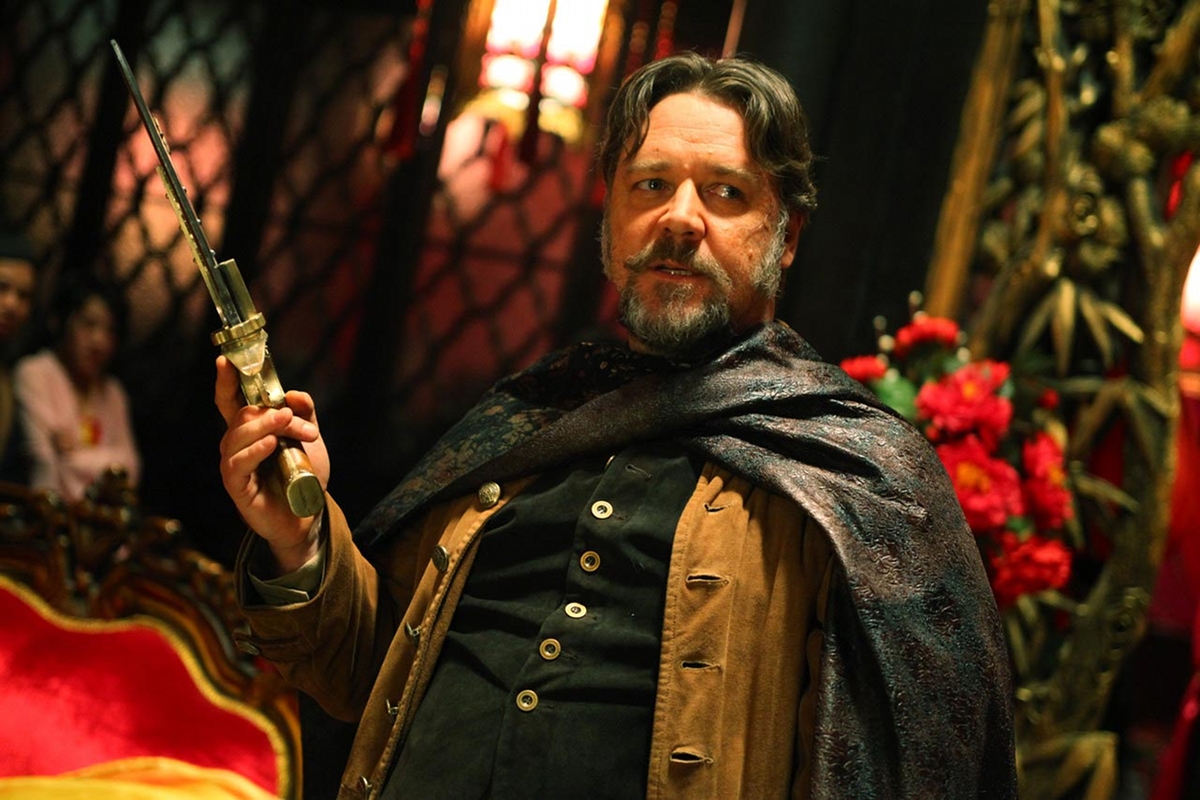
This same friend was also the one to introduce to me the New York rap group Wu-Tang Clan, often called the greatest and most influential hip hop group of all time. Nobody sounds quite like Wu-Tang, which is why the group has managed to keep their status for almost twenty years. De facto leader RZA apparently had as much respect for the old-school martial arts flicks as my childhood friend, because he directed and stars in The Man with the Iron Fists, an homage to the genre with big name stars Russell Crowe and Lucy Liu on hand.

That's going to be hell to clean out of the carpet.
Jungle village has its share of problems. The many clans are constantly at war, and the average folk just do their best to avoid being caught in the middle. When the Lion Clan, led by the treacherous Silver Lion (Byron Mann), makes a grab for power, every man, woman and child in Jungle village is in terrible danger. Their only hope of salvation? An opium-addicted mercenary (Crowe), the deposed son (Rick Yune) of Lion Clan's former ruler and the outsider Blacksmith (RZA), skilled in making exotic weaponry.

Oh, yeah. And Lucy Liu leads a brothel full of trained female assassins, as well.
The best parts of The Man with the Iron Fists? Well, leads Crowe and Lucy Liu add a bit of class to the cast, with an amazing on-screen chemistry that wishes you could see more of their characters together. Liu possesses the same charisma and allure that she brought to Ally McBeal over a decade ago, and forces control of every scene she enters. And Crowe, who was only able to be on set for ten days, does more with his role in that limited time than he has managed in the past decade of dedicated roles. For the first time in a long time, Crowe actually looks like he's having FUN. Maybe if he took roles like this more often, people would think more highly of his talents. Besides, they can't all be Gladiator. The soundtrack is solid and memorable, with new music not only from Wu-Tang but also The Black Keys, Kanye West and My Chemical Romance. The balance makes for one of the more pleasantly diverse soundtracks in recent memory, and stands out as one of the film's main selling points. The action scenes are decent, with no major problems sticking out, though for a movie with such obvious reverence for the genre, I wish there had been more major fight scenes than the few included.. MwtIF also carries with it a wonderful campiness; it's difficult to be too critical when things are far too silly, both visually and verbally, to really be taken seriously in the first place.

His name? Wait for it... Jack Knife.
Of course, that doesn't mean the experience is flawless. This is RZA's feature directorial debut, and it painfully shows on multiple levels. A couple of actors - Mann and Cung Le - manage to put in decent performances, but most of the acting is so bad that it completely defies the "so bad it's good" category, especially the surprisingly weak Yune. Worse is former WWE superstar David Bautista as a prototypical villain. But the absolute worst parts of the cast are the insipid Jamie Chung and RZA himself. Chung has shown no sign of improvement after poor appearances in Sucker Punch and The Hangover Part 2. All the potential she once had has turned to vapor, perhaps never to be seen again. RZA is slightly worse an actor than he is a director, taking himself and his film far too seriously and only popping during a brief flashback sequence close to the movie's climax. His dull narrative is a problem, as it's obvious he doesn't trust the audience to follow along such simplistic lines, or couldn't find a better way to convey it. You need a scorecard to keep track of all the characters and double crosses, and many potential storylines were left either on the drawing board or the cutting room floor. It's obvious that while Quentin Tarantino has attached his name to this, it's only in the most perfunctory sense; he definitely did his part to inspire this, but Man with the Iron Fists has a purely primordial feel, possessing Tarantino's carnage without any of the abject social commentary.

The Eyes have it!
As martial arts flicks go, Man with the Iron Fists will most certainly go unnoticed and unseen by general filmgoers. It's not a bad experience, and you get the feeling that RZA will improve with future projects, though perhaps he should choose one side of the camera and stick to it. But it's also a very specific experience; you know exactly what you will be getting into, and most people won't care one way or the other how this one turns out. RZA emulates the feel of a classic martial arts film, but never does anything to expand that experience for others. For hardcore martial arts fanatics, this is a must-see. For everyone else... not nearly so much.