Wednesday, January 11, 2012

Up in the Family Tree

I finally saw the George Clooney vehicle The Descendants this past week. Why has it taken me so long to get around to seeing a title nominated for several industry awards and listed on dozens of best of 2011 lists? Well, ever since trailers started appearing this past fall (and it feels even longer ago than that) I can't say was all that impressed with the material or reasons presented for seeing this motion picture. Well, to be honest, there was only one thing about the film that really turned me from seeing this as soon as it came out: director Alexander Payne. Payne is an acclaimed director, but his previous films Sideways and About Schmidt, which his latest trailer are quick to mention, are not nearly the amazing releases that so many have celebrated over the years. Jack Nicholson practically SAVED About Schmidt from itself, and there wasn't one non-detestable character in Sideways. So here we come to The Descendants, a film that looks good on paper but has the demerit of including Payne as its main creator. Still, there was no way I was going to miss seeing this title amid the awards season, and so when the opportunity came to see it this past week with my family, I begrudgingly accepted. I'm glad I did, as I can easily say that The Descendant deserves its place among 2011's best.

We solve crimes
Taking place in urban Hawaii, The Descendants introduces us to Matt King (George Clooney), who is as worn down a man as you can find in the state of Hawaii (where the story takes place). His wife is in a coma from a boating accident, leaving Matt in the dubious situation of raising his two daughters Alex (Shailene Woodley) and Scottie (Amara Miller) by himself while she recovers. Matt is also the trustee of a family trust that controls 25,000 acres of land, which the family must sell due to the rule against perpetuities. The family was just about ready to sell the land when Matt's wife had the accident, and as the sole trustee, Matt has been trying to decide what to do about it. Doctors have told Matt that his wife is not going to wake up again, and by her own instructions the doctors are going to take her off life support, meaning she's only days away from passing. Now he is traveling around Hawaii, telling family and a few close friends about what is happening so that they can say their goodbyes. Alex has no interest in talking about mom, however, and when Matt confronts her on this, she reveals a secret he never knew; his wife was cheating on him with another man.

He might be a lesser-known Bridges, but he has his brother's hair
What separates The Descendants from its predecessors is that there are no gimmicks to detract from the story or message. This might be thanks to the source material, in this case the novel of the same name by Kaui Hart Hemmings, which I've never read but has doubtlessly become more popular since this film's release. Unlike in his previous efforts, Payne's characters FEEL genuine and three dimensional, with no stilted cliches mixed in. Matt's wife, played by Patricia Hastie, doesn't have a single line of dialogue, and yet is STILL completely characterized through the people who know her. This depth of character is what separates The Descendants from many of its contemporaries, and really draws you into the story, which without that depth might be far less impressive than it turns out. Another nice touch is the scoring. While we're told early on that living in Hawaii is the same as living anywhere else and is not really the "paradise" many call it, one unique aspect is the amazing soundtrack full of authentic Hawaiian music. This is the first American film to be scored entirely with that state's traditional music, and tunes from masters like Gabby Pahinui, Raymond Kane, and Keola Beamer are perfectly set against he beautiful sunsets and sandy beaches of many a person's vacation destination. While I wouldn't recommend listening to the music by itself (it's slowly paced and only for true fans of the genre) it does make an amazing accompaniment to the main show.

How much product to you think he puts in that mop, anyway?
Of course, those aforementioned deep characters would be nothing if not for the amazing acting in portraying them. There's no surprise that the best are Clooney and Woodley as the troubled and disconnected father and daughter, who each undergo transformations throughout the course of the story. Clooney is (as he always is these days) brilliant, but I was really lifted by the strength of Woodley's performance. 2011 proved to be a breakout year for several actors, and the Secret Life of the American Teenager star proves she has what it takes to be a lasting presence in mainstream film for years to come. Many of the side characters are played expertly by veteran performers, including standouts like Robert Forester as Matt's stern father-in-law and Judy Greer as a woman Matt meets while traveling the state. Another young prodigy is Nick Krause as Alex's friend Sid, a mouthy neanderthal of a teen who turns out to be more perceptive and helpful than he at first lets on. And Beau Bridges is masterful as Matt's cousin, one of the many who will benefit from the sale of the land. While he only appears in a couple of scenes, Bridges masterfully commands his scenes and is only behind Clooney and Woodley in terms of pure screen presence.

No backseat driving!
The film does have a few issues, however those that exist are nowhere near what I was expecting. The film does meander in a few locations, though those are thankfully easy to ignore. The biggest issue I had with the film was the opening monologue consisting of Clooney's voice over to set the story in motion. With the actor going on for seemingly ten minutes to start the film, I was afraid that Payne would take a "tell" instead of "show" approach when it came to storytelling. Thankfully, that voice work ends completely after story setup is finished, and the rest of the film is told from a far more subtle perspective, with character interaction, visual imagery and deft facial expressions moving us forward. Never are we confused as to what is going on, though the film does hold back some small details to keep the audience from knowing too much too soon. And the ending is thankfully free of ridiculous cliches or unbelievable plot resolutions, resulting in a refreshing change for your dollar.

Best Supporting Actress of 2011?
Despite all these great things, How The Descendants really surprises is by truly becoming more than the sum of its parts. Between the excellent acting, superb storytelling and deft direction (proving Payne has what it takes to make a truly great film), this film manages to crack the year's Top 10, coming in at number 10. Not bad for a film I had discounted early on, proving that prejudgment of a film or the quality of its trailer have no basis in how the final product will finally be. As for Clooney and company, if you're one of those people who watch all the Oscar films. than The Descendants was probably already occupying a solid portion of your radar. If not, take the time and see this truly worthy title.

Friday, January 6, 2012

Tinker Tailor on Mr. Anderson


When British author John le Carre released his fifth novel featuring Secret Intelligence Agent George Smiley in 1974, he can be forgiven perhaps for not realizing what he had on his hands at the time. The first novel in what became known as his Cold War-set "Karla Trilogy" went on to become a bestseller of international proportions, had radio and television adaptations made, and remains one of the best known British novels to date, completely revolutionizing the spy drama in the process. So when Tinker Tailor Soldier Spy finally was given the cinematic treatment by director Tomas Alfredson (who made the original Swedish Let the Right One In), there were those fans of the book whose response was “it’s about time!” It helped that the cast brought in was chock full of talent, from standouts like Gary Oldman and Colin Firth to perhaps lesser known Tom Hardy and Toby Jones. Would any of these stellar abilities get any lasting recognition for such a renowned title? And how does this well-anticipated film fare over the course of a two hour movie when both previous adaptations had to be slotted into seven-part miniseries? My trek to the theater to add this to my yearly film allowance would hopefully answer that.

Gary Oldman: classic curmudgeon
In the wake of a blown operation in which British spy Jim Prideaux (Mark Strong) is shot and captured by Russian intelligence operatives, a shakedown is performed at the top of Britain’s Secret Intelligence Service, forcing out "Control" (John Hurt), the SIS’s director, and his right hand man George Smiley (Gary Oldman). Control is convinced however that one of the four men left in charge of the SIS in his departure is in fact a mole, funneling secrets to Russian Intelligence. When Control, already ill, passes away, it is left to Smiley to ferret out what few clues can be found and to see which of the four operatives, code-named Tinker (Toby Jones), Tailor (Colin Firth), Soldier (Ciaran Hinds) and Poorman (David Dencik), is the culprit, and whether the mole has anything to do with the top secret source of intelligence from Russia, known only as “Witchcraft”.

Yes, books... you might have heard of them
As I mentioned before, the exhaustive cast is one of the major draws if Tinker Tailor appeals to you. Gary Oldman reminds us of what a star he used to be in the nineties, as recent years have seen him starring in less-than-reputable titles or tagging on side roles in big series' like The Dark Knight or Harry Potter. Given center stage, however, he cuts a swath through the material in front of him, with every deliberate motion and dour grimace given for a very good reason, with no wasted energy to muddy up his delivery beyond exactly what is needed. It doesn’t hurt that he’s surrounded by a stellar supporting cast, most notably Colin Firth as a rival Intelligence head and one of those suspected to be a mole. Firth plays up the clichéd British arrogance for the role, but because he’s Colin fricking Firth his performance doesn’t come off as trite or silly. Other standouts include Toby Jones as the smug new head of the SIS, Benedict Cumberbatch as Smiley’s confidante and overly cautious agent, and Mark Strong in a relatively small role as Jim Prideaux, the agent (and Firth’s character’s best friend)  whose capture sets off the whole mess. Kathy Burke impresses in one scene as a foul-mouthed source of information (I guess her character had a larger role in the book), vacillating between helpful and flirty with Smiley. Unfortunately, crushing the story of the book down to a two-hour film means a whole got left out, including a lot of back-story for suspects played by Ciaran Hinds and David Denick. It’s a shame as both are well-regarded actors who would have benefited from a little more screen time. Also impressive is rising Hollywood star Tom Hardy as young agent Ricki Tarr, whose appearance in London allows Smiley clues to the mole in his midst. Hardy, nearly unrecognizable with a shaggy head of hair, shows that no matter the role, no matter how out of place it might seem for him, he can do it. It’ll be a shame to see his career go mainstream (such as in the upcoming This Means War), but if there’s any justice in the world, his name atop billboards will inspire people to see his films sooner rather than later.

What's more ridiculous; his career ascension, or his hair?
The aforementioned plot compressions create other problems besides just glossed-over characters. On one hand, the story feels told as if no crucial details are left out, and the tension the film bears throughout feels completely natural to a spy thriller like this. On the other hand, the tension is born from square one, with little downtime for the viewers to stop and catch their breath amid all the potential treason. While no major details feel left out, the same cannot be said for minor, clarifying ones, and some narrative miscues will throw the viewer off for whole scenes at a time, especially some featuring Mark Strong early on. Overall, the whole thing feels as though you need to have read the book to fully appreciate the experience of seeing this film. This is unfortunately the byproduct of plot shrink, and thankfully it’s no more than a minor nuisance on the film as a whole. Sure, some characters and plot points would have made far more sense with a bit more prodding, but for the most part such details would have been nice additions, not necessary exposition.

He may not get an Academy Award, but he's still Colin Firth!
For a film based on a beloved novel, there were certainly plenty of places where a lesser filmmaker would have screwed up. Thankfully, Alfredson did his source material due diligence and brought together the perfect cast, melding them into a story that would have devolved into drawn-out mumbo-jumbo without a strong hand to guide them. This is one of the few times I will argue that a film should have been LONGER, but thankfully this is no reason not to see what amounts overall to a very good film. While perhaps not reaching “Must See” status, it’s just a rung below, and even if you don’t see this Tinker Tailor Soldier Spy in the theaters, I hope you’ll at least consider it a serious rental in a few month’s time. More importantly, I hope the Academy will show the film and especially lead Gary Oldman more love than the Golden Globes have. Oldman deserves a Best Actor nomination for his efforts, as much for how he has been ignored in today’s Hollywood as he has been vindicated in this international thrill ride.

Wednesday, January 4, 2012

Artistic License


Well, what do you know? For the last quarter of 2011, ever since I saw Nicolas Winding Refn’s stellar Drive, the Ryan Gosling throwback drama has been my favorite release of the year. Between its excellent cast, stellar visual directing and strong story, Drive was an easy choice for that top spot. Sadly, a slow box office performance (exacerbated by the 3D re-release of The Lion King) resulted in an underrated status, and the film has garnered hardly any award attention, a poor response to one of the more visually emotive films of the year. Sometimes though, the industry gets it right. For months, I had been hearing nothing but great things about The Artist, the French-produced black and white silent film. Besides these simple descriptors however, I knew nothing about the movie itself; I wasn’t even sure that it really was a silent picture. Then the platitudes started coming out. It was nominated for the Cannes Film Festival’s Palm D’Or (eventually won by Terrence Malick’s Tree of Life) and has been nominated for 6 Golden Globes, the most of any movie for 2011. For all that, the actual subject matter of the film was still unknown to me, and for that reason I had no expectations heading into The Artist when the film finally became available in my area this past week.

They're congratulating you for actually paying attention
It’s 1927, and actor George Valentin (Jean Dujardin) is the biggest star of Hollywood’s silent film era. He knows it too, constantly putting on a show for his fans, who eat up the antics of Valentin and his talented dog, who doubles as his best friend. Meanwhile, Peppy Miller (Berenice Bejo) is an up-and-coming actress who befriends and develops feelings for the established star. At this point, things are going well. Soon, however, changes begin to appear. The invention of Talking Pictures revolutionizes the movie industry, with more studios using the new format every day. Despite George’s assertions that “Talkies” are a fad, even his producers get in on the act, dropping its silent film stars and going giving younger stars like Miller a big push. As Peppy Miller’s career soars to new heights, George Valentin drops to new lows, and the struggling performer tries to coexist with a world that has never needed to hear his voice before today.

Well, that answers that
Likely one of the reasons I reacted so positively to the story presented in The Artist was likely that it was very similar to another film I saw in 2011, the classic Singing in the Rain, which also dealt with the end of the silent film era. As amazing as that musical turned out to be, I was far more impressed with the implementation of The Artist’s self-imposed silence and the hurdles it had to overcome in the narrative department. Essentially a silent film concerning the end of silent films, every performer needed to emphasize their visual cues to make up for the fact that you can’t understand what they’re saying, and all the performers are more than up for the challenge. Jean Dujardin especially has to be the most visually emphatic performer, and he does so with such energy and gusto that he is immediately appealing even though we never hear his voice throughout the entirety of the film. With apologies to Michael Fassbender and his outstanding performance in Shame, Dujardin has become my newest Oscar favorite, with the strength of his performance knowing no bounds. Still great (if not matching up to Dujardin’s level), Bernice Bejo shows a propensity for the needed physicality for silent films while putting up a strong performance in her own right. Secondary characters including John Goodman, James Cromwell, Missi Pyle and Penelope Ann Miller do good work in limited appearances, though the biggest actor not a lead is Uggie, a Jack Russell Terrier who accompanies George Valentin everywhere. Uggie will arguably be the biggest star to come out of The Artist, and when you understand the wealth of talent around him, that’s no light compliment.

It's so meta...
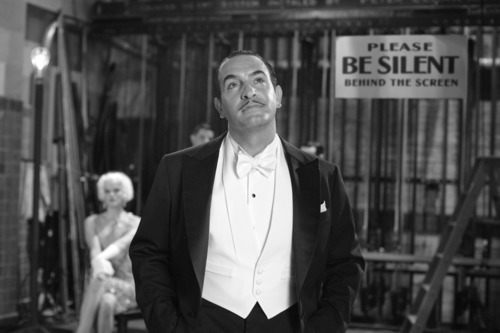
While it’s amazing to see a real, honest-to-god silent film on the big screen, it’s almost as nice to see where the film deviates from the more happy-go-lucky titles of that age. When George pisses off his female lead, she gives him the finger; stuff like this was never portrayed in the 1920’s (or for several decades after) and modern-day additions like this makes the film more honest and emotional. There is also a number of metaphysical scenarios that are hilarious in the context of the film (watching an audience watch a silent picture, a sign that asks for people behind a screen to be "silent", George’s wife asking him why he “won’t speak”) that really help add to the humor inherent in the script and cast. There’s never a dull moment, and even though you cannot hear the inflection in a character’s delivery, you can get enough from their gestures to understand the gist of the funny. The Artist also features some physical humor, but thankfully the film doesn’t bet the bank on it, preferring you to actually laugh at the situations and not the jokes.

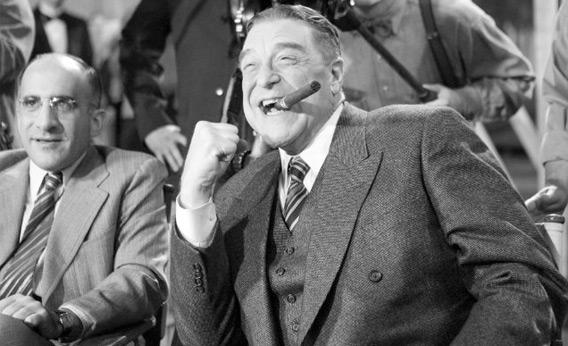
He smokes a big honking cigar; you know he's in charge
But it’s The Artist’s heart that really makes it the best movie this year. Yes, that’s right, I said it; The Artist is 2011’s #1 film. Thanks to director Michel Hazanavicius, the film is simultaneously different from everything you've ever seen while completely comfortable in the moment. At times both funny and sad, melancholic and hilarious, The Artist is easily the year’s most well-rounded release. Even if the idea of a silent film turns you off, trust me and go out to see this release. It is the best movie of the year, it SHOULD be treated like the best movie of the year, and you’ll be kicking yourself if you miss the best movie of the year.

Tuesday, January 3, 2012

A Dark New Year


Okay, so my prediction of reviewing award-worthy films starting this week didn’t mean that I would do so right away. Sure, The Artist, Iron Lady, and War Horse are going to get my attention sometime in the next month, as we start getting ready for the Academy Awards and other award ceremonies in the near future. That’s a given. These films will either surprise me with their ingenuity or depress me with their overrated aspects, but doubtlessly they will go unforgotten by myself and whoever does get out to see them. That said, the first movie I’m reviewing this year is The Darkest Hour, a film that didn’t grab me because of an interesting cast, unique story or even its sci-fi leanings, of which there are precious few these days. No, I went to see The Darkest Hour based solely on one name: Timur Bekmambetov. Name sound familiar? Perhaps you have seen his famous Russian vampire films Night Watch and Day Watch. More likely you remember his 2008 major American release Wanted, starring Angelina Jolie and James McAvoy. Since that time, he has stepped further behind the scenes, spending more time producing movies for others than directing than creating his own films. Despite that, I’m often sure that when he takes on a project, it’s because there’s something about the story or idea that he loves, and I so would love to have another experience like Wanted or even the animated 9 when it comes to Bekmambetov’s name. I’ve yet to do so, but I figured The Darkest Hour would only last a short time in the theaters anyway, so if I was going to give it a shot, this would definitely have to be the time.

This is the future of mankind. Be very afraid.
 
When entrepreneurs Sean (Emile Hirsch) and Ben (Max Minghella) find themselves screwed out of a Moscow business deal by a shady associate, they are trying to drown their sorrows when they run into two tourists, Natalie (Olivia Thirlby) and Anne (Rachael Taylor) stranded in the city. Just as the four are enjoying a good night in Russia’s club scene, power goes out throughout the city. That’s strange enough, but when what looks like an atmospheric disturbance turns out to be an invasion of invisible aliens who start turning humans into ash, the four find themselves trapped in a devastated Moscow, with the hostile aliens and their plan standing between them and being able to go home.

Here's hoping for a quick death for the star of Speed Racer...

 
Upon first review, you would think that The Darkest Hour is a cheap sci-fi film with little to recommend it. Well, that’s true, but that doesn’t mean such a movie has to be un-enjoyable. The film is definitely feels like a low-budget thriller, with the relatively cheap acting talent, gaping plot holes and murky camerawork lending nicely towards that idea. But a cheap thrill-ride can be fun when the film doesn’t dwell on what it ISN’T. When the film kills off characters by swiftly turning them into ash, the effect is seamless and cool, and the idea of the aliens themselves is inspired too. Though the film has caught some flack from reviewers for being unimaginative with their “invisible” aliens, I thought the idea of an enemy unseen by the naked eye as inspired, and for much of the film the tension of not being able to completely see the enemy worked out nicely for drawing the audience into those scenes in which they appear. There are some late-film scenes in which we actually can see the aliens themselves that show the weaknesses in the film’s CGI usage, and by far the scene in which we see what they look like is the most disappointing. That, plus some truly poorly-done imagery seen through the aliens' eyes, detracts somewhat from otherwise impressive SFX work, which of course means that the part of the film that HAD to be the best fails to do so.

The spunky kid has to live, but they won't make it easy!
That brings me to another area of contention with this film: the 3D. Going in, I wasn't expecting a cheap sci-fi thriller to be filmed in 3D, but then again there have been so many inappropriate titles that have used the technology that I really shouldn't have been surprised when the usher handed me 3D glasses to accompany my ticket stub. It's been a while since I've really ripped a film for being 3D, and just last year there had been only a couple of films I could stand in that medium. But the past year has been a source of solid 3D releases as studios finally have begun to understand what makes a GOOD 3D title in this day and age, and The Darkest Hour at least is closer to that end of the spectrum, with it's use in the film's atmosphere (mostly sifting dust) laying a nice framework for the story and drawing the audience more into the scenes. Unfortunately it doesn't do much more than that, and when combined with the unimpressive creature effects, the film as a whole manages to become less entertaining in the final act.

There are no big stars in The Darkest Hour; that means anyone is fair game
I almost feel bad to get on the subject of the characters and acting here, but for the sake of completionism let's get this over with. Basically, there are no characters worth mentioning here. Sean is a loser/nice guy who also moonlights as an annoyance to those who don't know him, a role that matches Emile Hirsche's appearance perfectly. Max Minghella, best known to this point for his supporting role in last year's The Social Network plays another cliche, as Ben is the more reasonable and responsible member of the pair. It's obvious that no effort was made to differentiate these heroes from any in film history, but at least these two have more personality than either of the film's female leads, as Olivia Thirlby's Natalie and Rachael Taylor's Anne are little more than panicked damsels in distress for occasionally hinted romance. It's so bad that director Chris Gorak brought in young Veronika Ozerova as a spunky teenage survivor to try and make up for it.

Well, he's still alive. Damn.
While setting the film in a post-invasion Moscow is indeed an inspired turn, the lack of decently compelling characters and a terrible final act ensure that you'll leave the theater with a not-nice opinion of your time spent. And yet I cant completely condemn The Darkest Hour for it's flaws. It's an underdog film, seemingly released at the same time as guaranteed blockbusters, for the sole purpose of failing miserably. And when you really think about it, the film is no worse than your impressions going in. Under the right circumstances and in the right mood, you can easily enjoy The Darkest Hour for the popcorn thriller it is, and makes for a nice reprieve from the supposedly high-class titles that have made themselves more apparent to you. I still wouldn't recommend you see it in the theater, but a DVD rental in a few months would be just about right.