Showing posts with label Paul Giamatti. Show all posts

Thursday, May 8, 2014

Not So Amazing

People don't like to think about it, but the Spider-Man franchise NEEDED that reboot. After Sam Raimi's disastrous 2007 finale to his to-that-point beloved trilogy, Sony needed to get people excited about the franchise again, and reminders of "Emo Peter Parker" were not going to work. And so while the 2012 reboot The Amazing Spider-Man was not universally loved for rehashing the character's origin story, it WAS a well-crafted, superbly-performed summer blockbuster that succeeded in washing away the stink of Raimi's failure. The question now was whether the first sequel in this reborn series could maintain that momentum, especially with at least two sequels and two spin-off films planned for the future. It's a lot to place in the lap of director Marc Webb, whose only experience before 2012 was the indie sleeper hit (500) Days of Summer. Could an inexperienced filmmaker with one monster hit under his belt be counted on for another slam dunk? If you read the title for this review, you have probably already guessed that no, he did not.
Suit up!
To be fair, not everything that is wrong with The Amazing Spider-Man 2 is Webb's fault. In continuing the story of Andrew Garfield's maturing superhero and his relationships with those closest to him, there were bound to be hiccups along the way. The sequel sees our hero during the summer after his graduation from high school, unsure how to pursue romantic interest Gwen Stacy (Emma Stone) without putting her in danger, as he has made a name for himself cleaning up the streets of New York City. But he's also dealing with the fallout of mega-company Oscorp, whose CEO has just passed away, leaving son (and Spidey's childhood friend) Harry Osborne (Dane DeHaan) in charge of the corporation, and also accidentally birthing supervillain Electro (Jamie Foxx), whose obsession with the superhero turns deadly. On top of that, there are dozens of additional characters, plot threads, foreshadowing and aimless cameos (Hi, Paul Giamatti! Bye, Chris Cooper!) that keep the plot rumbling forward. And if you used that last sentence to sum up what was wrong with this film, you would be pretty spot on.
The romance!
You see, Sony - who owns the film rights to the character of Spider-Man - is trying desperately to compete with the "cinematic universes" which have become trendy among those studios out there powerful enough to be in the business, with Disney (The Avengers), Fox (The X-Men and Fantastic Four) and Warner Brothers (The Justice League) banking on those continuous, interconnected stories to fuel their respective franchises for years, if not decades, to come. Sony however has less to work with; they own the rights to one hero, one or two anti-heroes and a slew of imaginative villains. While Spider-Man is already a cash cow for them, they would love to make a bundle off of Venom, Sinister Six and The Black Cat if it was at all possible. And The Amazing Spider-Man 2 definitely drops breadcrumbs in those diverging paths, setting up not only future sequels, but what they hope will become new franchises. But that's also what holds this sequel back, as the story itself suffers from a serious lack of focus due to all the clues that are cool on the surface, but detract from the primary plot.
The bro-mance!
So how does a film franchise transform from a refined storyteller to the rambling drunk down at your local pub? My money is on screenwriters Alex Kurtzman, Roberto Orci and Jeff Pinkner, who replaced the first movie's James Vanderbilt, Alvin Sargent and Steve Kloves. Kurtzman and Orci are certainly talented scribes, however their projects seem to swing the divide between fun and exciting (the recent Star Trek films, TV show Sleepy Hollow) and terrible (Transformers: Revenge of the Fallen) with alarming regularity, and with little middle ground. Their strengths (and presumably Pinkner's, from working with them on Fringe) tend to be bombastic, action-filled sequences fitted around frenetic bursts of character development. While that in itself is fine, their style feels woefully inadequate to properly represent Peter Parker, a character who is not so much about macho action (though he's no slouch) as he is about inner turmoil and conflict. I hate comparing a sequel to the first movie, but Webb and his previous screenwriters had an EXCELLENT understanding of what made their characters tick, while here the new team seems more interested in fueling new franchises than allowing their movie to stand all on its own. The Peter/Gwen romance is hastily constructed, poorly written and painfully trite. The Harry Osborne character - while excellently acted by DeHaan - feels tacked on and undeveloped, not given enough time for non-comic fans to ascertain his motivations. There are WAY too many secondary characters with too many shallow, unfulfilled storylines, and Webb isn't even allowed to address the dangling threads he left open in the FIRST movie, such as the hunt for Uncle Ben's killer. But worst might be the way the film treats Jamie Foxx's villain, whose origins and rationale are about as cliched as comic book bad guys get. For a the sequel to a film that helped usher in a new age of superhero flicks, this followup is definitely a bit too safe and familiar for fans to rally behind.
No, wait, forget the bro-mance...
All this isn't Webb's fault, though he's hardly free from blame. His actors all acquit themselves nicely - which in addition to the ones I've already named also include Sally Field, Colm Fiore, Felicity Jones and Marton Csokas - lending to the fact that Webb is indeed an actor's director. Standing out, Garfield and Stone share some excellent chemistry, and even Garfield and DeHaan feel like genuine old buddies, despite the failings of the screenplay. And the action-packed fight scenes are well-done, though the special effects accompanying them don't look quite as impressive as they did two years ago. The 3D is especially disappointing - even by the low standards I've come to set - so I definitely don't recommend paying the extra cost to view it that way. But what Webb does most wrong is wilt under pressure, both from his corporate overseers (who doubtlessly demanded all the script's added nonsense) and from those who were disappointed in his work the last time out. While The Amazing Spider-Man carved its own image into the big screen, the sequel feels reminiscent and even derivative of Raimi's popular entries, from the bright colors to the cartoonish characterizations, diverting sharply from what we've seen before. And then he can't even get the pacing down, as whole storylines hinted at in the trailer are never even mentioned, no doubt edited out in a mad dash to meet deadlines and satisfy executives.
Explosions are much brighter this time around.
There are moments in The Amazing Spider-Man 2 that live up to the pedigree that the first film afforded, but those are sadly few and far between. I'll give Webb some credit: this movie had lofty goals in mind, from its role as the catalyst to Sony's new cinematic universe to its adherence to the important Spidey stories fans grew up with. This man pulled his cast and crew together and collectively they did their best to turn a script with zero focus into something both entertaining and emotional. That they got as close as they did is primarily due to the talent in the director's chair. However, this is a spectacle that tries too hard to do too much and falls far short of even modest expectations, becoming easily the most disappointing superhero flick of the past decade. Whether this puts a hiccup in Sony's future plans of course cannot be known, but hopefully the next Spider-Man entry will be a step back up for a studio with their ambitions, because if The Amazing Spider-Man 3 is not a major step up from this mess, the future of the franchise is in serious trouble.

Wednesday, December 25, 2013

'Saving Mr. Banks' from Himself

You wouldn't be wrong to look at Disney and assume that they run the planet at this point. Over the years, they've been amassing huge tracts of business landscape. They own animation juggernaut Pixar. They own and operate ABC and a host of other television programming licenses (including 80% of ESPN). They bought Marvel Entertainment, bringing an entire stable of profitable superhero franchises under their already-sizable roof. And this time last year the company purchased legendary studio Lucasfilm from science fiction scribe/legend George Lucas. That's right; Mickey Mouse owns Star Wars.

Naturally, this is an exciting time to own stock in the corporation (The Lone Ranger notwithstanding), but it's not hard to look back about fifty years, when Disney only SEEMINGLY ran the planet. It was the 1960's, when the company was much, MUCH smaller, but the affect it had on modern culture was never in doubt. Disneyland was one of the world's top tourist destinations, and every movie coming out of Disney's celebrated studio was an instant gold mine. Walt Disney himself was a beloved public figure, despite the allegations of racism and antisemitism that arose during what has become known as the Golden Age of Animation.
Get used to this face... Apparently Mrs. Travers wore it a lot.
And that's a life worth exploring on film, even if only in the minimalist, somewhat pandering efforts of Saving Mr. Banks. The movie recounts the untold story of Disney's (Tom Hanks) twenty year effort to adapt his daughters' favorite novel - "Mary Poppins" - to the big screen. Only one obstacle stands in his way: author Pamela "P.L." Travers (Emma Thompson), who is only agreeing to the deal on the basis that she has final say on the production. As heads collide, Travers reminisces to her early years in 1900's Australia, and her memories of an alcoholic, yet loving father. Gradually Disney begins to truly understand what it is that makes this novel and the character of Mary Poppins so special to this British author, though their difficulties make the production of one of cinema's most endearing family classics very, very hard to get done.
I think they hired Hanks just to deflect any controversial asides.
This feel-good picture comes from John Lee Hancock, and upon reflection it makes perfect sense that the director of The Rookie, The Alamo, and The Blind Side was on hand to crank up the inspirational vibe on this motion picture. The characters are all good folk, trying to get things done, and learning a bit about one another in the process. And in Thompson's case, that's worthy of some serious Oscar consideration; her performance as the successful, eccentric and somewhat protective author is right to draw raves, as she takes on a character that a lesser actor would have made either cringe-worthingly annoying or mind-numbingly sappy. Credit where it's due, some of that brilliance does come from the screenplay - co-penned by TV writers Kelly Marcel (Terra Nova) and Sue Smith (Mabo) - which features a wealth of witty dialogue, plenty of heartfelt moments and quite a bit of genuine emotional inflection. But it's Thompson who makes the role special, taking someone who could easily have been portrayed as a shrew - or worse, a villain - and making her sympathetic to everyone in the audience.
Much music was made on that piano, and... other stuff...
And it's not just Thompson that shines, as most all the cast put forth some of their best efforts to date. Jason Schwartzman and B.J. Novak light up the screen as the renown songwriting duo of Richard and Robert Sherman, who created such classics as "Chim Chim Cher-ee" and "Supercalifragilisticexpialidocious", while West Wing and Cabin in the Woods fans will recognize the charming Bradley Whitford as Mary Poppins screenwriter Don DaGradi. Paul Giamatti turns in his casual "lovable schlep" as Travers' unwitting but friendly personal driver, certainly not a bad deal. And of course Tom Hanks is having a stellar year; between this and his excellent work in Captain Phillips, it's officially a comeback year for the veteran leading man. Casting him as Disney is a no-brainer, as there isn't an audience out there that cannot be pleased by Hanks' cool demeanor and earnest expressions. But the scene-stealer in Saving Mr. Banks is undoubtedly Colin Farrell, who appears in Travers' flashbacks as her troubled father. Again, it's a role (lovable drunk) that could so easily have been botched by a no-name performer, but Farrell really draws the audience in and allows us to get into the soul of his character. In return, we get to appreciate some of the best work from one of the industry's more under-appreciated actors working today.
Wait, when did this become Heidi?
Unfortunately, despite some stellar acting and more than a few feel-good moments, Saving Mr. Banks is far from a perfect product. Thompson's jokes almost always work, but the screenplay doesn't really allow anyone else (with the occasional exception of Disney himself) to get a jibe or zinger in. And when they do, well, they're usually not all that good. It's all about the interactions between the two main stars, and while the actors who play those secondary parts ARE quite good, they can't quite overcome the limitations of the script. There's also a distinct sense of whitewashing when you see the movie. Even if I hadn't been told about some of the egregious lies the movie would have you accept as fact (despite it said that she'd only published the one book, Travers actually had written quite a few books between "Poppins" and the movie's production, and she actually HATED the movie itself) I wouldn't say I could have been surprised. It's a movie BY Walt Disney Studios CONCERNING their parochial namesake; of COURSE there's going to be more than a bit of image massaging going on. The creative changes do make sense, but my issue has more to do with the blatant nature of Hancock's ham-fisted direction than it does with eschewing historical accuracy. Frankly, if Hancock was a better, more subtle director, he might have made this film into something truly exceptional.
Ah, the days when everyone wore ties...
As it stands, Saving Mr. Banks is certainly a serviceable, solid, and even quite sweet film. If you were looking for something to take your family to over the Christmas break, it's one of the stronger options out there, though Frozen is still the clear front-running option. While there's no getting past the fact that Banks is a flawed motion picture, it's got an abundance of charm and sufficient talent in front of the camera - especially in its two leads - to carry itself quite effortlessly into the hearts of any audience. Excellence it could have reached, especially in regards to its love letters to fathers, but for a sycophancy that ironically advocates forgiving troublesome dads without acknowledging it's own parent's missteps. Still, Thompson is looking at a well-deserved Oscar nomination (if not a win), and there ought to be a good deal of fun had at the movies should you decide to make this your destination.

Wednesday, July 31, 2013

Double Feature: R.I.P.D. and Turbo

The common theme for today's double feature is Ryan Reynolds. Back in the early 2000's, the Van Wilder actor was going to be the next superstar of the big screen. Unfortunately, while still a talented performer, he's never quite achieved the level of career prosperity that folks once predicted, and his Hollywood experience has consisted of peaks and valleys, with most of his appearances coming in supporting roles and his biggest draws being shared with bigger, more prestigious actors (Denzel Washington in Safe House, Sandra Bullock in The Proposal). He's certainly been busy this year, with roles in TWO animated features (the first was The Croods) and one sci-fi action film. We'll look at the live-action flick first, as Reynolds teams up with Academy Award-winner Jeff Bridges in RED director Robert Schwenke's R.I.P.D.

When Boston Police detective Nick Walker (Reynolds) is killed in the line of duty, his soul does not go to Heaven or Hell. Instead, it is transferred to the Rest in Peace Department, an afterlife police agency that tracks down bad souls on Earth that have escaped judgment. Partnered with former US Marshall and curmudgeon cowboy Roy Pulsipher (Bridges), the pair clash frequently in their search for hiding "Deados". But when an ancient artifact is discovered that threatens to return the dead to the Earth, Nick and Roy must settle their differences before the world as they know it comes to an ectoplasmic end.
Bridges is of course playing Rooster Cogburn.
On paper, R.I.P.D. seems to look something like a cross between Men in Black and Ghostbusters, with a decent amount of Ghost thrown in. Based on the comic book series of the same name from Dark Horse Comics, you figure that there would be plenty of material to mine in putting together the story. Unfortunately, Schwentke's final product is rushed, cramming potentially two and a half hours worth of material into a slim 96 minutes. Everything is hurried, with no chance for the audience to slow down and adapt to the idea of the R.I.P.D. and its role in protecting the planet in secret. The result is that the story comes off as phony and unbelievable, and the films that should have been sources of inspiration (the three above) are instead mined for specific imagery, their theft leaving R.I.P.D. without an identity all its own. The special effects are at least better than you might expect, but the quality isn't consistent, switching between good and mediocre in a heartbeat.
R.I.P.D. even stole M.I.B.'s secret locale.
There are two factors in which the film does redeem itself, however: humor and acting. Annoying physical humor aside, R.I.P.D. actually has excellent dialogue, which is crisp and helps alleviate the mediocrity of the overall story. And that humor really comes across thanks to a cast not just composed by its leads, but also by Mary-Louise Parker, Stephanie Szostak, and Kevin Bacon, who has really enjoyed a career renaissance on screens big and small the past couple of years. They manage to elevate the movie by a couple of rungs, and both Reynolds and Bridges carry the film through the strength of their constant interactions.I do wish the director had stepped away from the duo a bit more to focus on the support cast, but otherwise I can't really complain, as the result is entertaining enough.
Get to the choppah!
But despite some fun that can be had, it's hard to get around the fact that R.I.P.D. could have been much, MUCH better than it turned out. It's just too derivative to fully get behind, and while it's not nearly the train-wreck that many critics have attested, for the money that was allegedly spent ($130 million got us THIS?), it's definitely going to go down as one of the most disappointing comic book adaptations this year. It might be worth a rental in a few months, but don't rush out to see it just yet.

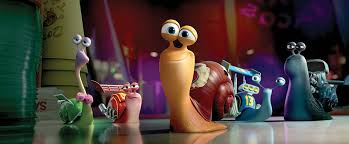
A much better Ryan Reynolds jaunt (and one for the whole family, no less) is the latest animated film from Dreamworks, Turbo. If you were to take Ratatouille, change the animal in question from rats to snails, and then fuse it to Cars, you have an idea of how this one plays out. Theo (voiced by Reynolds) is an average gastropod, weary of his slow-paced existence and dreaming of becoming a world-class racer like his heroes on the NASCAR circuit, much to the chagrin and embarrassment of his sensible older brother Chet (Paul Giamatti). When a freak accident with nitrous oxide turns Theo into the super-fast snail Turbo, his dreams of going fast quickly become true. Soon, he is teaming up with fellow dreamer and taco truck driver Tito (Michael Pena), whose family business is suffering due to its poor location. Tito and Turbo hatch a plan that's so insane and unbelievable that it could only happen in a Dreamworks movie, as Tito uses all his saving to enter Turbo into the Indy 500, racing against the top car racers in the world. But could Theo's powers be only temporary, and if they are, what will happen if he slows down during the big race?

Turbo; a snail with a plan.
Like all Dreamworks animated pictures, Turbo is quite pretty to watch, but not quite on par with its superior competition. The company's response to the idea that they aren't as deep or emotional as those put out by Pixar (even over the last couple of years, Dreamworks has struggled to maintain its second-place status on the animation front), the response has apparently been to crib the best themes from Pixar's highlights (in this case the excellent Ratatouille). First-time feature director David Soren at least does a decent job with his second-hand story, mixing the idea of never giving up on your dreams with a healthy mix of characters.
Just stand back and let the merchandise sales roll in.
And it's the characters that stand out most in Turbo. Excellent actors such as Paul Giamatti and Michael Pena hold key roles, and the gang of renegade racing snails (which feel remarkably akin to the Fast & Furious gang), are a lot of fun. They're led by Samuel L. Jackson, but Soren never relies on them to pick up the slack elsewhere. In most films, that would be a great sign of restraint, but here it seems a little foolhardy. Turbo, and Reynolds as his voice, are interesting enough to maintain their lead character credentials but is a bit vanilla for an animated lead. Though there's a great cast in here, they can't quite make up for an uninspired lead.
In the grand scheme of Dreamworks animated films, Turbo is certainly not bad. On a scale between the excellence of How to Train Your Dragon and the much-reviled Shark Tale, their latest comes in somewhere around Kung Fu Panda. While the concept is almost as absurd as it is derivative, kids will definitely get into seeing this animated feature on the big screen, and unlike a lot of Dreamworks' other titles, Turbo has enough for adults to get into the act, especially if they're fans of the still-growing race culture. But with Monsters University and Despicable Me 2 still in theaters, I can't see any reason you should rush out your door to see it either, unless your kids really love the idea of racing snails. Or if you do. No judging.

Monday, June 18, 2012

Movie Monday: Rock of Ages

This weekend didn't offer much in the way of "great" entertainment, so Todd and I flipped a coin and saw Rock of Ages, the musical based on the Broadway show of the same name. We weren't sure what to expect, but we were certainly hoping that it couldn't be worse than attending That's My Boy.

In 1987 Los Angeles, two young singers trying to get their big breaks in Hollywood are Sherrie and Detroit-born Drew. Meeting by chance, the pair fall in love, but enter conflict when success shows itself on the horizon. Legendary rock band Arsenal is about to put on their final show before legendary rocker Stacee Jaxx embarks on his solo career, a concert that will save the Sunset Strip's iconic bar/showroom The Bourbon Room, and its embattered owner, from financial ruin. But The Bourbon Room, the Strip, and rock & roll finds itself under fire from religious conservatives, led by the mayor's wife, who seems to have a special grudge against the soon-to-be-solo Jaxx.

Rock of Ages is directed by Hairspray's Adam Shankman and stars Julianne Hough, Diego Boneta, Russell Brand, Paul Giamatti, Catherine Zeta-Jones, Mary J Blige, Malin Akerman, Alec Baldwin and Tom Cruise. It also features music from Poison, Bon Jovi, Twisted Sister, REO Speedwagon, Journey, Foreigner, Def Leppard, and other eighties bands, and an original song by Porcelain Black.


Click here for the full review at Open Letters Monthly.

Monday, October 17, 2011

Electoral Foul-Up


To hear the industry tell it, Ryan Gosling is the hottest actor in Hollywood as you read this. While much consternation was raised earlier this year over Gosling’s apparent Oscar snub for his role in the indie drama Blue Valentine nobody can doubt the attention he has earned in 2011, in which he has had arguably his biggest year to date. In fact, today marks the third review I’ve written in three months that has starred the young actor, the first two being the romantic comedy Crazy Stupid Love with Steve Carell and the noir crime drama Drive. With The Ides of March, Gosling takes on the world of political intrigue in a film directed by co-star George Clooney. Clooney knows what it’s like to be the hot hand of Hollywood, as he has managed to build a strong career based especially on his charisma and excellent acting. Clooney has had twenty-five years to ascend to that status, with his starring turn in the CBS medical drama E.R. and a robust film resume that has seen plenty of misses but even more hits, and he was a huge reason films like Out of Sight, Michael Clayton and the Oceans trilogy were so well received. His directing career, however, has been a different story. While 2005’s Good Night and Good Luck was a true gem (and probably would have won its best picture nomination had Crash not come out the same year), other films directed by Clooney have been far from well received. Still, the good will Clooney has generated from audiences goes a long way, and his latest attempt behind the camera takes one of the more talented young men in Hollywood to see what he can do with Mr. Gosling.
Wait, does that sign say George Clooney is Evil? Blasphemy!
Based on Beau Willimon’s play Farragut North, the story follows Stephen Meyers (Gosling), the junior campaign manager for Democratic Presidential hopeful Mike Morris (Clooney). Having served on more electoral campaigns than most have by the time they are forty, Stephen is a true believer in the Governor of Pennsylvania. He believes that Morris is not only the best candidate for whom he has worked, but the only one who can and will actually make a change for the good of the country. Currently they are campaigning alongside senior campaign manager Paul Zara (Philip Seymour Hoffman) in Ohio, hoping for a victory in the Primaries here that will easily secure the Democratic nomination. But while this is going on, Stephen discovers a secret that not only throws his confidence in Morris in doubt, but could officially end the Governor’s political career. Now he must determine which is the better option: making sure his flawed man reaches the White House, or throwing in with the competition and rival Tom Duffy (Paul Giamatti) to make sure that Morris doesn’t reach that goal.

Sadly, Clooney's inspiration did not help "Bring the Sexy Back" to the campaign trail
If you want to enjoy The Ides of March, you might have to love politics. I’m not saying this because the film is unapproachable to those who don’t, but the learning curve is certainly steep enough for the uninitiated. The actors involved toss out factoids concerning political history almost at random, and though they are no doubt at least somewhat essential to understanding the scene they are almost completely forgotten by the time the closing credits rolled. You can either take in these random bits of information as a pure sideline entertainment and by turn having a leg up on your fellow movie watchers, or you can ignore them completely and try to just follow the mood of the story as it goes along. The latter is certainly where most would tread, but unfortunately you can’t get the full campaign experience without trying to understand why the characters act the way they do. Thankfully the major themes are ones that EVERYONE should be able to understand, and that the film succeeds in not completely alienating its audience it a minor victory.

Presidential jaw, Presidential hair... you sure he's not a Republican?
Unfortunately, that’s about all this film can say went right, as even those political aficionados would have little reason to sit through The Ides of March’s entire 101 minutes. Doubtless there are any large number of conflicts in a Presidential campaign, but why on Earth did Clooney and company have to make the entire thing so DULL? Perhaps it’s not entirely his fault, and the Willimon play is at least part of the problem. That still doesn’t excuse the fact that a film full to the brim with devious schemes, political intrigue, scandals, deception, blackmail and revenge is so utterly uninteresting to watch. What should have been keeping me riveted to my seat instead kept me waiting for something, ANYTHING to happen. With surprisingly horrid pacing, I simply didn’t care about this candidate, this election or any of the underpinning issues that went into it, and that is certainly the fault of the filmmakers.

Some people will just never be happy
At least an excellent cast has been brought in to somewhat raise the level of the tepid script. Gosling once again argues that he belongs in Hollywood’s upper echelon. While not near as memorable as his previous starring roles, he is still perfectly cast as the closest thing the audience has to a hero. Stephen is smart, talented, charming and experienced, and should be easy to root for. Even when his character’s morals and methods change, Gosling is entirely in control. Easily the rising star of 2011, his dedication to roles like this should cement his future superstardom. Clooney as a Presidential candidate is not all that different from Clooney in the public eye: he’s charming, looks the part and can speak publicly with the best of them. In short, Clooney carries the perfect political persona. His performance might be a little on the nose (and therefore lacking the diversity to be interesting) but since many celebrity hounds already see him as a potential Presidential front runner, he was in fact the best choice for the role. Philip Seymour Hoffman has always been a strong character actor. Once again however he is an actor straining to be free from the confines of a singularly rote character, even one with some devious methods all his own. Hoffman is most certainly too much actor for the part he plays, but he still brings a ton of professionalism and talent to the cast. Possibly shining most brightly is Paul Giamatti as an unscrupulous campaign manager who tries to tempt Stephen to joining the other side. Smarmy and duplicitous, it’s easy to pin the main antagonist tag on his head, and it’s difficult to believe that this is the same guy who was the hero of this year’s indie dramedy Win Win. Like Hoffman, he’s one of the most talented character actors in Hollywood today. Others who contribute are The Wrestler actresses Marissa Tomei and Evan Rachel Wood. Tomei is a political journalist for the New York Times, while Wood plays an intern and romantic interest for Stephen. Both have their roles to play, and while Tomei is limited in scope for her character, Wood turns out to be almost a kindred spirit to Gosling, and the attention that gets focused on her is not put to waste in even the slightest fashion. Jeffrey Wright is another talented performer, but unfortunately his character – an Ohio politician whose endorsement would be essential to Morris’ victory – harbors too much of a vibe copied from baseball Hall of Famer Reggie Jackson (right down to the facial hair), with his own aspirations above that of the people he represents.

Sadly, Morris' other slogan "Hope" was already taken
Clooney might be responding somewhat to much of the populace thinking he’d be a great political frontrunner (and he might at that), but in The Ides of March he presents so jaded and dark a vision of the American political system that there is really no cause for even the smallest hopes of purity to arise. Between that, the bland dullness of a script, too many cliched characters and sheer lack of imagination (they reuse a famous scandal to try and move the story forward) take this film from being one of the big contenders of 2011 to somewhere amidst the pack of wannabes. When a political thriller doesn’t particularly THRILL, it’s a cause for serious concern, and this title has the feel of a half-baked drama that was rushed out the door. Sadly, this might even be the wrong time for The Ides of March to be released, as the demonstrations occurring across the country suggests that people have had their fill of corruption for the time being. The Ides of March is not Oscar worthy, but it does have enough going for it to perhaps fool many into thinking otherwise. If you’re big into politics and want to see a bunch of talented actors do what they do so well, this film will whet your palate nicely. If not, then when I see you next we can move on.

Monday, June 6, 2011

Hair of the Dog

When The Hangover was released in theaters two years ago, it was an unprecedented hit. Opening on June 5, 2009, the film went on to make nearly $470 million worldwide, a reign of success for an R-rated comedy not seen since the days of Beverly Hills Cop and other eighties classics. Simply put, The Hangover's success shouldn't have happened, what with the rare diamonds to be found in the comedy business. The film, telling the tale of three emotionally-adolescent men who manage to lose the groom after a particularly raucous Las Vegas bachelor party and wake with no memory of the night before, was so successful that a sequel was not only pondered but practically inevitable. Only two years later we have that product, one of 2011's most awaited summer releases. Reuniting the "Wolfpack" of The Office's Ed Helms, Zach Galifianakis (for whom these films have imparted his lifetime role) and Bradley Cooper, The Hangover Part II was made to capitalize on all the good will its predecessor had sown. Of course, I thought the original was an overrated farce with few actual laughs, so would I be impressed by a revamped (and relocated) remake?

Somehow this year's fashion shows amounted to more of the same
This time, the Wolfpack of Stu (Helms), Alan (Galifianakis), Phil (Cooper) and Doug (Justin Bartha) are on their way to Thailand, where Stu plans to be married to his new fiance Lauren (Jamie Chung) in her family's homeland. After what was supposed to be just a friendly drink between the four and Lauren's younger brother Teddy (Mason Lee), Stu, Alan and Phil wake up in Bangkok with no memory of how they arrived there. Worse, they've somehow lost Teddy in the streets of that legendary city, and with only a little time left before Stu must be back to say his "I do". It's business as usual, as the three sort-of-friends unite once more to locate their missing comrade.

Of all the films to make in Bangkok, why this one?
To be honest, if you've seen The Hangover, you pretty much know what is going to happen here as well. The characters are even in on the joke, frantically shouting that it's all happening once more. After the setup that establishes everything you NEED to know, one of the cast disappears. Later, he is found. In between, a LOT of crazy shit goes down. This IS Bangkok after all, and there's a reason the city has the reputation it has gained from popular culture, such as John Burdett's series of novels centered in Bangkok's seedy underbelly. That this only serves to rehash the same schlock over again in a new setting is disappointing, even if some of the scenes are even more outrageous than in the first film. Director Todd Phillips obviously didn't want to mess with a winning formula, but that doesn't excuse the film's lack of courage, as the film only pushes the envelope slightly beyond the same specific boundaries of of the 2009 original.

A monkey replaces the sunglasses-wearing baby, because... you know... you can't shoot babies.
The Hangover Part II also features the return of most of The Hangover's original cast, and that doesn't just mean the heroic trio. Helms, Galifianakis and Cooper all practically live these characters during the film's shooting. Helms plays the perpetually nervous Stu as second nature by now, and of course Cooper is completely at home as rugged ladies man Phil, but neither is very far from their happy medium. The characters are easy for them to portray, so it's not like they had to put a ton of effort into Stu and Phil's personalities. Galifianakis suffers from the same problem, but balances that out by being a million times more entertaining than any of his co-stars. Even if he plays a man who you would never be friends with in a million years were he to exist in real life, you can forgive Alan's silliness when he regularly smacks your funny bone into submission. Possibly the most irreverent film character of the past decade, Alan MAKES The Hangover, and there wouldn't be a sequel without him. Though the women are all but ignored, it's nice to see Jamie Chung in a 2011 film that doesn't COMPLETELY suck (I'm looking at you, Zack Snyder), and she makes a better leading female than Heather Graham ever did. Acclaimed director Ang Lee's son Mason manages his first major role well, though the role of an over-parented wiz-kid son is hardly anything but a cliched role for an Asian teen. Justin Bartha has a slightly larger role in this sequel but doesn't really get to be a part of the main story, and with his mainly uninteresting character that's okay. Finally, villain Ken Jeong returns as an ally to the Wolfpack in Bangkok. Though most find his broken-English speaking criminal offensive, I thought he was the second-funniest part of the entire film. Throw in award-winning performer Paul Giamatti as a an American "business man" and the cast is talented enough to avoid completely embarrassing themselves with the juvenile dialogue and cliched scenarios.

"Oh, WHAT will I do until Due Date 2 comes out??"
One of the worst things I can say about The Hangover Part II is... it's not particularly funny. For the amount of hype and attention the film got, you would expect wall-to-wall laughs, especially considering the material used. Despite the filmmakers' efforts to make everything so much crazier and zanier, the humor largely falls flat, and some sequences are more awkward than anything else. Sure, I got some fun out of watching part deux, but as I was at a midnight release event, I can probably attribute some of that brief gaiety to dehydration (the air conditioners in the theater were offline), exhaustion and sleep deprivation as much as anything on the screen. Sure, the first Hangover struck both box office and critical gold, but if more of the same is all we can look forward to in its sequels, then we should all hope this latest night out is the finale.

Friday, April 1, 2011

Winning

My history with the work of Tom McCarthy has been somewhat of a surprise. While I'm sure I'd recognized his face from earlier, minor roles, I first became truly aware of his existence from his role as dishonest journalist Scott Templeton during the fifth season of HBO's excellent TV show The Wire, which I'd caught on DVD. I hated his character, but only because McCarthy (whose name I didn't even know at the time) was so damned good playing a jackass. After that, I swear I began to see the guy everywhere. When I watched the excellent 2008 film The Visitor (do yourself and check it out if you haven't already), I was shocked to see in the special features that the director was in fact the same Tom McCarthy, the very man I'd seen months previously. Then there was the amazing animated film Up, which had McCarthy on staff as a writer. After all this I'm building a lot of respect towards this artist, who seems to do great work and create objects of true entertainment value. And so when I see a trailer for McCarthy's latest directorial piece, it of course catches my attention. Win Win seems to have all the feel-good aspects that make for an entertaining theater visit but what might make this the biggest film for McCarthy's career so far is the acting talent involved, most notably award-winning and Oscar-nominated actor Paul Giamatti in the lead role. It may be limited to smaller theaters at the moment, but that only encouraged me to diverge from my usual routine and see the film at the Coolidge Corner Theater here in Boston, a practice I'd advise to any and all who are able to watch this great film.

Being sent to the Principal's office: never fun
Mike Flaherty (Giamatti) is going through a rough patch. His small law practice is floundering. Money is tight. The school wrestling team that he coaches is completely hopeless. In short, nothing is going right for Mike, and he dreads having to reveal all this to his wife (Amy Ryan) and two daughters. Becoming the guardian for an elderly client named Leo Poplar (Burt Young) inadvertently introduces Mike to Leo's grandson Kyle (Alex Shaffer), who ran away from home and his addict mother. Now under Mike's care, Kyle helps turn things around by joining the school's wrestling team and helps put them on a streak of wins that help alleviate the family's problems and steer Kyle toward greatness... at least until his mother Cindy (Melanie Lynskey) arrives in town, looking to take home a son who wants nothing to do with her.

Hopefully fans of The Office will flock to see Ryan in this
Amazing acting abounds here, and there's not one weak performance in this whole bunch. Giamatti, who most recently won a Golden Globe for his similar portrayal of an everyman in Barney's Version, is just as compelling here as a regular Joe who suddenly gets the chance to control his crazy life for the first time in a long while. As always, Giamatti is the best part of his film, though several others do come close. It's especially amazing to see a guy who's not a Clooney or a Pitt do so exceptionally well; Giamatti is a symbol to actors of all ages that pure good looks can't preclude amazing talent. Shaffer makes his feature film debut as troubled teen Kyle, and you wouldn't know it to watch his performance that he's fresh blood. Perfectly personifying the youth at risk that we hear about every day, Shaffer's character is one you can't help but root for, as he goes from aimless to determined over the course of the film's events. Amy Ryan may have had better roles the Oscar-nominated Gone Baby Gone and The Wire, but her amazing work here can't go unnoticed. Going from a wife and mother who doesn't trust Kyle under her roof to one who connects with him so closely that she sees him as the son she never had, Ryan is just too wonderful, and if you don't know her talents by now this would be a good place to start. Some of the best scenes in fact focus on the budding relationship between her and Kyle, as they learn more about the other. You wouldn't think Bobby Cannavale to be a great actor to look at him, but you can't help but love Terry, Mike's best friend and confidante who got dumped by his wife for his contractor. Cannavale steals many of the scenes he's in, hopefully gaining himself a few fans in the process. Great smaller roles are filled by Jeffrey Tambor, Burt Young, and especially Melanie Lynskey as Kyle's druggie mother. With this cast, there are no weak points, and this helps really keep the audience vested in each small sub-plot as well as the main story.

Did you know Melanie Lynskey is from New Zealand? Me either!
With such great characters, you need a narrative that does them justice. Thankfully, that is covered by the wonderful tale McCarthy himself pens. Fully believable, the film taps into the financial crunch middle America is currently feeling, while managing to feel timeless as well; I can imagine watching this again ten years in the future and still connecting to the story as easily as I do today. Sweet but not so much as to be saccharine, and funny but not for the wrong reasons, the different sides of Win Win blend into the perfect concoction of relatability, honesty, and "aww"-inducing moments. It's obvious McCarthy set out to make the perfect feel-good film, and thanks to his efforts he succeeds with flying colors.

Unitard enthusiasts need apply
It's often tough to judge indie films like this against those of much larger Hollywood budgets, which can often afford whatever they want. The limited funds of indies also often leave them with glaring holes or deficiencies, easy to pick out and disappointing compared to the rest of the film. Win Win is not one of those films. It may not be on the same level of McCarthy's The Visitor (which was it's own brand of simple beauty), but Win Win is the kind of film that will make you stand up and cheer, not only for the film's talent but the strong message it tells. For that it's my new #1 film of 2011. Everything a good film should be; if you're lucky and it comes to a theater near you, choose it over Battle: Los Angeles and other massive Hollywood fare. I think you'll be pleasantly surprised how a little bit can go a long way.

Monday, February 7, 2011

Version 2.0

Today's review is for Barney's Version, based on the 1997 Mordecai Richler novel and starring 2011 Golden Globe winner Paul Giamatti. It would be fair to say that Giamatti's nomination for Best Actor in a Comedy or Musical was the main reason I wanted to see this film. A trailer seen not long after those nominations cemented it as a film of interest. Sadly, movies of this ilk tend to keep holding patterns active in limited release and wait until the Oscars are announced before making the final push for box office success. Sometimes this works, as films like Black Swan and The King's Speech made a lot of money in limited release before Oscar nominations and wide release. Sometimes, however, this backfires when a film garners no major nominations and pretty much missed their chance at the big payday. Barney's Version is the perfect example, as here was a chance to really push Paul Giamatti as a major acting force left instead in a gutter by the wayside. But that has to do with marketing and number crunching, which isn't my forte. So how does this title stand up as a film in its own right?

Challenging the idea that one can't look TOO Jewish
The film tells the life story of Barney Panofsky (Giamatti), from his youth as a layabout in Italy through the marriages to his three ex-wives (played by Rosamund Pike, Minnie Driver and Rachelle LeFevre), the disappearance and presumed death of his chemically-addicted best friend Boogie (Scott Speedman), and to the present day, where he recounts all this in the wake of his latest divorce and continued accusations of responsibility for Boogie's death by the detective who originally accused him. The story is presented from Barney's version of the facts (hence the title), and Barney himself is an uncomplicated character, making motions through life until he meets his true, and then does everything he can to keep her with him.

"I'm so high...look at my thumb! Weird..."
I've never read the book by Richler, so while I can't say I was a big fan of the film's story as a whole, I can't be sure if this is a problem inherent in the novel or simply in the transposing of the tale to the big screen. Barney's Version can't seem to decide what kind of movie it is. The film goes from being a coming-of-age tale to a romantic comedy, dabbling in buddy films and gross-out humor, and managing to incorporate a murder mystery between the margins as well. This is unfortunate because with such a jumbled storyline it's difficult to get a gauge on what we're supposed to be feeling towards the characters, especially Barney, who appears to go to and fro along the sympathy scale without any clear destination. This might not sound bad to those reading this, but trust me when I say that I'm sure this works much better in a four-hundred page book than a 132-minute movie. Also of some concern was the film's makeup, which garnered an Oscar nom but nevertheless couldn't make Giamatti look the same age as his cohorts at any given time. I suppose they deserve credit for getting CLOSE enough.

May it last longer than the first two
The performances, however, are what make the film as good as it is. Giamatti especially makes it onto a very long list of lead actors who SHOULD have been nominated for Best Actor at this year's Oscars but didn't make the cut of final five (talk about a category that could benefit from expanding to ten nominees). Though his character goes through a few periods where the audience would be fully forgiven for thinking him a complete and utter douchebag, Barney is more often than not a good man who falls in love, loses and gains friends and enemies, and undergoes a life transformation over the course of, well, his life. Often he's the main reason I kept my eyes on the screen, and for much of the film qualifies as it's savior. Rosamund Pike is also charming as Barney's third wife Miriam, who is the love of Barney's life, the one and only. Though you can't escape that Pike looks years younger than Giamatti at all points during the film (she's only two years older than ME, folks), their relationship is shown in a very realistic manner, and Giamatti can't take all the credit for that. While Pike is forced to work under a lot of aging make-up during the film's run, she still manages to convey a different type of heart than we've seen from her before. Not to be outdone are the first two wives, played by Lefevre and Driver. Lefevre, whose biggest role to date was the role of Victoria in the first two Twilight films (and lost that role in the third by committing to this one), takes a small role and makes it hers as the snotty young woman Barney knocked up to become his first wife. Driver's career prime may not have been as high as some hoped or expected, but she's still delightful here as his shrill, overly-emotional second. Scott Speedman puts on one of the better performances I've seen from him as Barney's talented but troubled best friend, and Mark Addy makes a nice turn as a hard-nose detective sure Barney is guilty of murder. Last and unfortunately least is Dustin Hoffman as Barney's ex-cop father. Hoffman is in his "Focker" phase, with the cliche Jewish persona in full effect. He's not BAD, per se, he's simply played this role far too long and far too often, and it shows. While he still cranks out the occasional award-nominated roles, this isn't one of them.

Is the makeup making him look older or younger? I can't tell
There were times where I really wanted to get up and walk out of the theater. There were times I was sure I was seeing a masterpiece. Unfortunately, these were parts of the same film. While Giamatti deserves every great attemtion for his role in Barney's Version, the movie itself is mainly blah. It ties up every loose end with an annoying lack of subtlety, and while the ending gets up there in the "masterpiece" rating, it doesn't make up for the rest of the film not getting the job done. Not a great movie, by any stretch, but I'd recommend it just to see Giamatti and crew exchange good dialogue over the decades.