I don't go a day without checking my Facebook page. Several times. In fact, it's safe to say I'm pretty addicted to checking up on the status and info of others. Heck, I'm on Facebook
RIGHT NOW, and a good chunk of people who read this blog are those of my friends who click on the links I put on Facebook whenever I put up a new post. To be sure, it's a huge part of my life, and for that matter for millions of people around the globe as well. Isn't it hard to think of a time before Facebook, with the impact it has on society today? And another film I recently posted about,
Catfish, was about how Facebook and social networking had influenced affected communication between distant parties. So it was only a matter of time before a movie dedicated to Facebook's impact was released for general consumption.
 |
| Would you distrust these faces? |
Director David Fincher doesn't want you to call
The Social Network "the Facebook movie", and there's actually a good reason for that. Though the film does in fact chronicle Facebook's birth and rise to maturity from "humble" beginnings as an exclusive networking site for Harvard students to the worldwide phenomena we now know it as, it's far from the movie's main focus. That focus is squarely on Facebook co-founder Mark Zuckerberg, whose genius birthed this creation and whose relationships between both friends and enemies set the drama for the story. Starting with Zuckerberg's girlfriend breaking up with him due to his ability to be an insensitive asshole (a theme throughout the film), Harvard undergrad Zuckerberg, played by
Zombieland's Jesse Eisenberg, goes home, rants about how his ex is a bitch (on LiveJournal; Is that still around?), and on the spot decides to create a program that allows participants to vote between photos of two female Harvard students (hacked from Harvard's multiple limited social networking sites), for the purpose of deciding who was hotter. Shortly after crashing Harvard's limited computer network due to so many people using the program (Harvard, by the way, is portrayed by several school campuses that are
NOT Harvard), Zuckerberg is approached by members of one of Harvard's elite cliques with the idea of creating a Harvard-exclusive social networking site that would essentially be an elite dating site for the men of Harvard. The site would eventually be known as ConnectU. Initially taking them up on the offer, Zuckerberg instead uses the idea of an exclusive site to create Thefacebook with best friend and fellow Harvard student Eduardo Saverin (your new Spiderman, Andrew Garfield) providing the financial backing. The film is told in flashbacks, with the current time showing Zuckerberg being sued not only by the ConnectU men who allege that Zuckerberg stole their idea, but also his former best friend Saverin who has been forced out of the management group at what has now become Facebook.
 |
| That's the future Lisbeth Salander on the left |
The film is helped by the fact that the story is charming to a fault. While one can (and should) question a ton of the "facts" presented here, the story itself is compelling and interesting. It's a shame that it doesn't get into the nitty gritty of the actual program itself, as the scenes that do are some of the best scenes in the film. But the human interaction is the meat and gristle of the story, and thankfully that aspect of the film is masterfully manipulated. The use of the flashbacks from two legal battles to Facebook's founding and rise is excellently done, and sets the pace of the film well. While the product may in fact be less than entirely honest, if those sacrifices were made to create a more interesting film, I'm okay with it.
 |
| The mathematical code to attending Harvard? Maybe... |
The acting is also exceptional here. Though it's unlikely any of the actors included will be up for major awards when the season arrives, it seems a shame that none would be recognized for their portrayals of these modern-day giants. Eisenberg was at danger of Zuckerberg being like most of his former nervous and antisocial persona, but while those elements are still in play here there's an aura of insensitivity here and also a tiny bit of humanity, which actually does a great job of rounding out the character. Zuckerberg is never fully vilified in
The Social Network, but while he is not put in a generally good light Eisenberg does somehow maintain a bit of in-over-his-head confusion that manages to make the character at least somewhat sympathetic. Garfield is probably the only actor in this troupe who has a shot at some supporting actor nominations come this winter, and that's because he plays the most human character in the cast. As the spurned Facebook co-founder, Garfield has to run the gamut of good friend to reluctant financier to screwed-over former friend in one two-hour film. Garfield is also the one we're supposed to feel most sympathetic for, but there's a problem there that I'll get to later. Garfield certainly earned no demerits, however, and his performance is a revelation for those out there who didn't know he existed before now. And Justin Timberlake is charming as former Napster-founder Sean Parker, who becomes an advisor to Facebook and later it's president. Timberlake is someone who (in my opinion) has made his career in music and acting on the firm basis of his considerable charm and personality, rather than on actual talent. Parker is portrayed as a fast-talking, slick-thinking genius always on the lookout for the next big thing, and one whose extravagance and inflexibility led to being kicked out of two former companies that he founded. The character was practically written for someone of Timberlake's talent set, and Parker also creates the most turmoil in the friendship of Zuckerberg and Saverin that leads to their split as friends and partners through his seemingly-phony charm and obvious personality clash with Saverin.
 |
| Revel in your popularity while it lasts, Eisenberg |
The film has a few issues, though they are big ones, mainly stemming from the ego of the director. Finch is usually known for his stylistically-shot films like
Seven,
Fight Club and
The Curious Case of Benjamin Button, but when he directs a biopic like this you would expect that he shouldn't even need CGI to tell this particular tale. Well, he didn't get the memo. In an early scene featuring two characters outside in what's supposed to be twenty-degree weather, it's plainly obvious that the steam coming out when they breath is computer generated, and plainly takes you out of the scene. But the big dereliction of director duties is staggering. Cameron and Tyler Winklevoss are twin brothers and Olympic rowers who are the main part of the ConnectU brain trust who sue Zuckerberg for stealing their idea, and are played by Armie Hammer. No, that's not a typo. Using a body stand-in and digital recreation, Fincher had Hammer play two parts while seamlessly inserting him into the scenes to play both parts (and neither twin is seen apart from the other). Hammer does a commendable job (and has the funniest line in the whole film), but Fincher could have saved a ton of trouble by, you know, hiring twins to play the parts. Though Hammer was good, it's not like he wasn't expendable, and it has to be chalked up to Fincher to make the job more difficult than it had to be. Yes, the job was seamless but he did it not because he had to, but because he could. Taking in this film means also taking Fincher's ego trip, sadly not a surprising development.
 |
| Sticking it to the Corporate man |
The film's biggest problem, however, lies in the audience's inability to really sympathise with the characters. This is no fault of the actors, who all put on award-worthy performances, but instead in the characters they are asked to convey. We're supposed to feel most sorry for Garfield's character, but we're specifically told that Saverin had made $300 thousand dollars the previous summer in oil ventures. Though he's screwed out of major Facebook ownership over the course of the film, it's really hard to feel sorry for him because you know he's smart enough and knows the right people, so he'll be okay. Same with the Winklevoss twins, whose idea is obviously at least partially stolen by Zuckerberg, but who came from a rich background to begin with. In fact, let's face it: most of the characters in this film are in attendance at Harvard, which means that they either come from rich families or their families know influential people (or both). I've never really lacked, and have been both fortunate and lucky to have the support of loving parents and have never gone hungry or without necessities. I firmly believe myself to me middle-to-upper middle class, and have only been to one year at college and acknowledge my shortcomings from not finishing. However, I've also been accused of being or growing up "rich" from those who grew up with less than I did, and so if
I can't find much sympathetic with these rich people who fight over stock options and millions of dollars, I can only imagine how true blue-collar audiences would feel about these same people.
 |
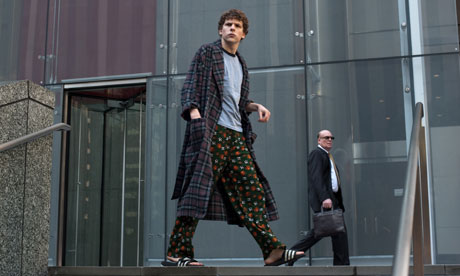
| The asshole at work... or is he at play? |
Which still is not enough to derail what is a
VERY good film. Fincher's hits outpace his misses in
The Social Network, and while the ego trip and unsympathetic characters drag down the film a bit, it still manages to place
#9 on my Top 10 Films list. In closing, I'm reminded of the Tina Fey bit when she showed up on Saturday Night Live in support of Hillary Clinton for the Democratic primary in the 2008 Presidential election. Admitting that Clinton was "a bitch", Fey went on to utter one of the more memorable TV lines of that year: "Bitches get stuff done." For Zuckerberg and others of his ilk, like id Software's John Carmack (creator of legendary games
Doom, Quake, and Wolfenstein 3D), the same principle applies. Facebook was created by Zuckerberg because he was the right type of person to create it and he turned to Sean Parker to help expand it because Parker was the same type of person. If assholes get stuff done, I can at least respect them for having the audacity to do it.
It doesn't mean I have to like them, however.