Showing posts with label Alan Tudyk. Show all posts

Friday, December 6, 2013

Disney's 'Frozen' Warm to the Touch

After nearly a decade of being left in distant third by Pixar and Dreamworks and seeing other rival animation studios surface worldwide, the once legendary Disney Animation has finally regained a serious foothold in today's crowded market. In Tangled and Wreck-It Ralph, they have created two of the absolute best family features in recent years (as I've pointed out, Wreck-It Ralph should have won the Best Animated Feature Oscar last year), and while they seem to be returning to a familiar formula with Frozen, directors Chris Buck (Surfs Up and Tarzan) and Jennifer Lee (who also penned the screenplay) show that Disney can still put on a kick-ass song and dance when given the opportunity.

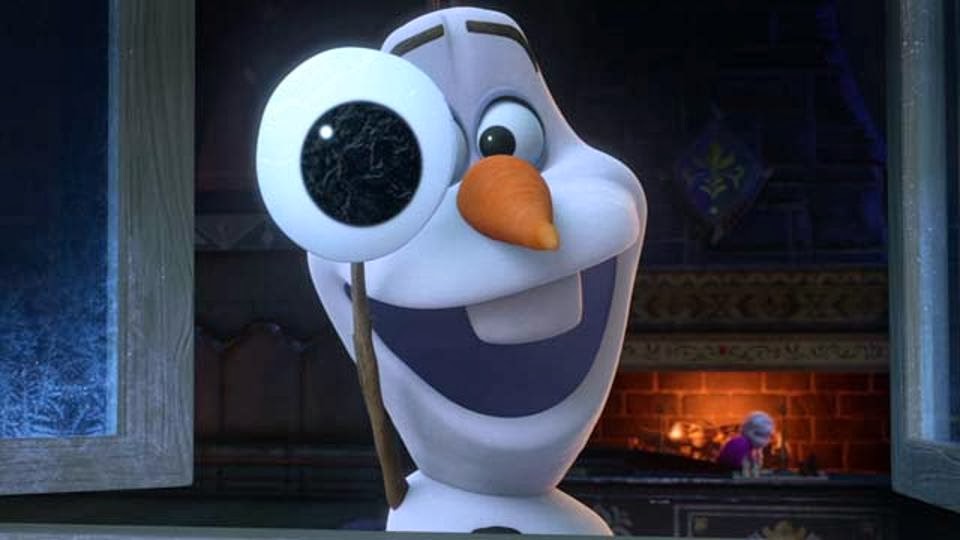
Loosely based on Hans Christian Anderson tale "The Snow Queen", Frozen is about sisters Anna (Kristen Bell) and Elsa (Idina Menzel), princesses in the glorious kingdom of Arendelle. For a long time they've been cooped up in their castle, separated not just from the world, but for the most part from one another. This is particularly hard on the lonely Anna, who remembers sharing joyous relationship with her sibling in the past. On the evening of her coronation as Queen, Elsa accidentally reveals to the world a power to control the elements, and when this incident results in her running away and the kingdom being awash in snow (in July), it's up to Anna - alongside gruff mountain man Kristoff (Jonathan Groff), his reindeer Sven and Olaf, a magical, living snowman (Josh Gad) - to becalm her sister and try to get the world back to the peaceful, sunny way things used to be.
Just your typical bubbly, overly-friendly, smart Disney princess... maybe...
For the first act, we are introduced to this land in the best possible way: a combination of lovely ice and snow and Broadway-quality song and dance. We're introduced to the sisters, the reason they drifted apart, and family tragedy, all to the enthusiastic harmonics of "DoYou Want to Build a Snowman" and "For the First Time in Forever". The musical score was assembled by Christophe Beck (whose impressive resume includes Pitch Perfect, The Muppets, and last year's Academy Award-winning short film Paperman) and written by Tony Award-winning songwriter Robert Lopez and his wife Kristen Anderson-Lopez, and their combined genius really shines in that first twenty minutes. Those amazing numbers (and to a lesser extent, Menzel's solo performance of "Let it Go") transfix the audience and combine with outstanding visuals to render the average viewer catatonic with emotion. It's the best example I can think of where a movie musical actually carries the charm of a Broadway play, without feeling like a cheap, misunderstanding castoff. It is here that Frozen is at its absolute best, as Beck and Lee make the most of their combined resources and start things off with an impassioned opening salvo of epic set pieces and glorious musical achievement.
No, you may not call him "Bumble".
But somewhere after this point, what makes Frozen truly an unique, prodigious treat is muffled a tad. It's not that the rest of the movie is without charm, or that it is not excellent in its own right; the directors do an amazing job of moving the story forward and keeping you rooting for our likable heroes. But in comparison to that astounding opening, the story just doesn't have the emotional momentum to overcome its limitations, from characters that aren't as deep as they are charming to a definite lack of story development. Besides the opening, Buck and Lee's biggest success is their treatment of the Snow Queen, which when all is said and done is nothing short of miraculous. Menzel's Elsa is not evil or even converted to evil by the fear of the other characters. She's simply misunderstood - more anti-hero than outright villain - and her character never really alters from the very good, very caring character that was established at the beginning. However, the quality of the musical numbers takes a downturn in the second act, and while they're all still quality songs delivered with spunk and dynamism, they don't get any better than those openers. There isn't even a final number - only a reprise of an earlier one - despite a relatively weak ending that would have benefited from a strong closing bit. Finally, despite subverting your expectations of the Disney Princess genre - no doubt due to Lee's work on the screenplay - the film prefers to skew uncomfortably close to that same style, and for the most part doesn't feel different from the Mouse's early, "Damsel in Distress" stories that really ought to feel old-fashioned in this day and age.
Because they have to make a billion dollars in merchandise, as well.
The dialogue is at least razor-sharp, and delivered by a surprisingly elite cast to boot. Sure, you have the unknowns, from Glee's Groff to Broadway star Santino Fontana (playing a seemingly prototypical Prince Charming) who deliver solid efforts. And the twin leads of Bell and Menzell are absolutely perfect, Bell a surprise as her career to this point isn't exactly rich with musical numbers. Nonetheless she does a great job as a charismatic heroine, fitting right in with the likes of Rapunzel, Belle and Pocahontas. Veteran Menzel has never had much of a cinematic career, her biggest effort to date coming in the adaptation of her iconic theatrical role in Rent. More known on Broadway, she takes her combined singing/acting experience and easily converts it to the big screen; some of the film's best moments feature either her understated yet powerful singing or her understated yet compelling acting. The cast is rounded out by veteran voices Ciaran Hinds and Alan Tudyk (though I wish they'd done more with both), and Gad fulfills the comedic sidekick role alongside Sven the silent reindeer. Though both provide laughs (Sven's antics are definitely inspired by Tangled's secondary hero Maximus), they're thankfully not overused, their humor providing just the right amount of levity comparable to their contributions to the plot. It's this excellent use of characters by the directors that keeps both the children and adults in the audience invested in the story through the final two acts.
Don't get in the way of her "Ice Fu".
And these strengths - alongside that stellar opening - are what make Frozen not only the best animated movie this year, but one of the best movies of 2013. There are definitely some gaffes when it comes to Disney's latest effort, and it doesn't come very close to the overall quality of Tangled or Wreck-It Ralph, let alone classics like The Lion King, Beauty and the Beast, or The Little Mermaid. Or almost anything from Pixar, for that matter. Even when the movie actively departs from its Princess-y roots, it never distances itself enough to morph into anything distinctive (a defect highlighted by the Mickey Mouse short Get a Horse, which runs with it), and the movie as a whole never really lives up to that outstanding first act. But demerits aside, this is a strong, fun, funny, delightfully subversive and emotionally engaging story for children of all ages and a must-see for anyone who has ever had affection for their siblings. It may not end up being long-remembered, but it certainly ought to be fondly remembered in the years to come.

Wednesday, April 17, 2013

Baseball is Back

In post-WWII America, much of the nation was enjoying a prime era. The "Greatest Generation" had returned home, triumphant over the evils of fascism and the Holocaust. But while we were celebrating our victory, evils were being perpetrated on our own soil, against our own citizens. Racism was still rampant in America, seeding itself everywhere but focused mainly in the deep south where Jim Crow was king and everything from schools to bathrooms were segregated in a laughable execution of "Separate but Equal." While all those policies were wrong, where it was most notoriously visible was Major League Baseball, at the time the country's most popular sport. Before expansion, before wild card slots, before interleague play and the World Baseball Classic, baseball culture was relatively simple and unparalleled. Still, the players, managers and umpires were all white (or at least light-skinned Latinos), with no consideration ever given to signing a black ballplayer to a Major League contract.

That changed in 1947, when Jackie Robinson became the first African American to break baseball's sacred color barrier and forever change the sport. That's where Brian Helgeland's 42 steps up to the plate. Robinson's story hasn't been given the big screen treatment since 1950's The Jackie Robinson Story, which starred Robinson himself. Looking back on perhaps the most important change in the modern sports era, the film looks at the Hall of Famer's ascent from great Negro League player through his first tumultuous season as a member of the Brooklyn Dodgers, winning Rookie of the year in 1947. That year, Robinson (Chadwick Boseman) had to face prejudice on all side, not only from society and rival teams but often from his own teammates as well. But with a rugged determination, no shortage of talent and the backing of the Dodgers' General Manager Branch Rickey (Harrison Ford), Robinson earns the respect of his peers to become the renowned player he is known as today.

Perhaps most surprising about this production is how it took so long to reach fruition. As I mentioned, there hasn't been a film about Robinson since 1950, a 63-year gap that seems strange when you consider Robinson's role in the Civil Rights era. Still, the final product was well worth the wait, even when you consider the fact that it comes from Helgeland, who proves himself a fine director despite his inexperience (he's a screenwriter whose only previous credits as a film director are A Knight's Tale, Payback, and The Order). He not only rebuilds classic rural America, with its dirt roads and classically-designed ballparks, but he captures the attitude of the era, the natural discrimination that can only be infused through generations of hate and ignorance. Helgeland also successfully navigates Robinson through this gamut of violent and nonviolent bigotry, painting a fairly clear picture of what the superstar had to endure in his historic first season.

Helgeland also does an excellent job with his cast, one of the strongest I've seen this year. Frequent television guest-star Chadwick Boseman gets his biggest role to date, and as Robinson his gravelly voice and barely-civil demeanor is the perfect balance for a character sick of the degradation he must endure to play the game he loves. Hopefully this will be the first step for Boseman, one of many African American actors officially making their presence known in recent years. But as much as I loved the young actor, the number one performance of 42 has to be Harrison Ford as the rule-breaking General Manager Rickey. For the first time in a LONG time, my first reaction to a Ford performance wasn't "Indy!" or "Solo!" In fact, I often had to remind myself that Ford was in fact the actor on screen most of the time, such was his astounding ability to disappear into the role. His performance, as well as Rickey's penchant for speaking in metaphors and hiding his true objectives, makes for one of the year's great characters.

And this movie is full of real-life characters, from Wendell Smith (Andre Holland), who would become the first African American member of the Baseball Writers Association of America; Leo Durocher (Christopher Meloni), the Dodgers manager who declared "I do not care if the guy is yellow or black, or if he has stripes like a %^@&in' zebra. I'm the manager of this team, and I say he plays. What's more, I say he can make us all rich. And if any of you cannot use the money, I will see that you are all traded" when speaking to his players of Robinson; Pee Wee Reese (Lucas Black), who famously supported Robinson even to his potentially hostile hometown fans; Ben Chapman (Alan Tudyk), the player/manager of the Philadelpia Phillies whose vocal efforts to ridicule Robinson on the field had the opposite effect of uniting much of Brooklyn around their star; and Rachel Isum Robinson (Nicole Beharie), the woman who was the tenderness behind Jackie's gruff exterior. Those great performances and more underscore the film's narrative, enhancing the story with its truly understandable characters.

Is it a perfect movie? No. Emotionally, Helgeland is still a little raw, confusing melodrama with compassion, cliche with character. There are moments throughout 42 which are so staged that they reek of ridiculousness, from the inspiration Robinson brings to a small boy to the blatant (though perhaps true) scenes of discrimination, the director occasionally stuffs his movie with unnecessary bits to try and enhance the drama. More often than not, though, he succeeds when the script calls for minimalism (a scene with Ford recollecting a white boy imitating Robinson's batting stance is exceptionally well-done). The story also has some glaring historical inaccuracies (especially involving the yearlong suspension of Durocher), though those are ultimately the exception and not the rule. The few stretches into humor feel forced, though they occasionally work despite their apparent deviation from the dramatic tale.

While it might not sit on the same pedestal as such baseball movies as Bull Durham, Field of Dreams or Moneyball, 42 surely isn't far behind. It belongs in the same discussions of The Rookie, A League of Their Own, 8 Men Out and Major League, and provides a better moviegoing experience than many of those classics. 42 harkens back to the days when baseball was America's #1 pastime, and gives a good argument for revisiting that ideal again. But even if you're no baseball fan, the movie's human drama and the legacy of Jackie Robinson are well worth your time and attention, especially since you don't want to wait another 63 years to receive this opportunity again.

Friday, November 9, 2012

Open Letters Monthly: Wreck-It Ralph

Sorry about the late posting this week, folks; this was supposed to go up Monday as per usual, but some unforseen delays got in the way. Still, I'm more than happy to inform you that Wreck-It Ralph is just the kind of uplifting, absolutely wonderful experience you hoped it would be.

In the after-hours of Litwak's Arcade, video game characters don't just get powered down. They converge on their own little universe in which good guys are good, bad guys are bad, and those who go against the program ultimately end up unplugged. Ralph is the villain of the popular game Fix-It Felix, Jr., but after thirty years of being the bad guy, he wants to change. Tired of being evil, Ralph embarks on a quest to become a hero, a difficult thing to achieve with his programming. Making friends along the way, Ralph learns a lot about himself and what it takes to be a hero, but will that realization come too late to help the friends he has come to care about?

Wreck-It Ralph is directed by Rich Moore and stars John C. Reilly, Sarah Silverman, Jack McBrayer, Alan Tudyk and Jane Lynch.

Click here for the full review at Open Letters Monthly.