Wednesday, January 12, 2011

A Vampire Movie that DOESN'T Suck

Somehow by now I thought I'd be done with 2010's films. 2010 still manages to sneak in however, most notably in films that don't even make their way to wide release until 2011 but count towards 2010 due solely to extremely limited runs that qualify those titles for the big award shows. This is not one of those movies. In fact, it's probably my most surprising 2010 film success story. Here in Boston, the Coolidge Corner Theater is one of our smaller, independent theaters that often focuses on the art house films. On weekends, the theater hosts its Coolidge After Midnite series, which comprise of cult and horror films shown at midnight to a small crowd of dedicated viewers. This past weekend, the film was Let Me In, the American remake of popular Swedish film and novel Låt den rätte komma in, which translates to Let the Right One In. Hollywood has gotten a bit remake-crazy lately, with both this and the upcoming Girl with the Dragon Tattoo quickly converted from worldwide popular Swedish films into Americanized versions to market directly to a local audience. Since I'd yet to sit down and watch the original Swedish edition, I was hesitant to take in the remake. But since Let Me In had gotten good reviews and since I wasn't in a hurry to see the original anyway, I figured "why not" and so "Southland Dan" and I trekked to the Coolidge to give this unseen film a shot.

Moretz auditioning for the "creepiest kid alive" award
The story of Let Me In focuses on young Owen (Kodi Smit-McPhee), a smallish loner constantly bullied by others at his school and suffering from an aversion to swimming. His favorite past-times include visits to the local arcade and spying on his neighbors through his telescope. His parents are getting divorced, and he doesn't feel much connection to either his emotionally-disturbed mother or his absent father. He doesn't have a friend in the world until the day an odd girl (Chloe Grace Moretz) moves into the apartment next door.

Uh... yeah... you don't have problems at all
The story gets a little bit into a few side characters, but for the most part the film focuses on the two juvenile leads. Moretz of course is familiar to anyone who remotely heard of the controversy surrounding her foul-mouthed superhero Hit-Girl in 2010's Kick Ass. Here she gives an outstanding performance as Abby, the child vampire. Abby is lonely from several lifetimes worth of moving around, stuck in an apartment while the man who cares for her goes out at night to hunt for fresh blood. Moretz's creepy-yet-fragile performance is even better than that of Hit-Girl, proving that she's no one-hit wonder. While Abby has no peers, Owen is alone while surrounded by them. Smit-McPhee wasn't as heralded in his role as Viggo Mortensen's son in The Road, but that role paved a path to a very impressive performance here. The victim of bullying, divorcing parents and now vampire necro-voodoo, Owen has to be a type of victimized everyman, and Smit-McPhee does a great job playing the straight man to the what would be otherwise unbelievable. Other good performances come from Richard Jenkins as a man who has been taking care of Abby for years, and Elias Koteas as a police officer following the bodies left in Abby's wake.

Awww, did you start the cranberry-crushing party without me?
As for the themes present in this tale, Let Me In brings up topics not necessarily seen in mainstream Hollywood films. Bullying is a major topic these days, especially with all the new legislation being passed by the government banning it in schools, which makes seeing the odd duck Owen bullied by other boys at school feel so real as we see it on the screen. In fact, the film asks a great question by exploring why the other boys pick on Owen at all, and really makes sense when you see it happen. The themes of alienation and loneliness play out well through the two child leads, and the idea of parental divorce is actually one of the best displayed themes in the film. Owen lives with his mother and she appears in several scenes, but from the get-go we never really get a good look at her, as she's seen either out of focus or from behind. In the film doing so, we get Owen's feelings of disassociation from her by never REALLY seeing her at all.

No, he's a police officer... NOT a child molester. He gets that all the time
It's a shame when a good film like this has problems, so it's a relief when those problems translate to the mere cosmetic. Special effects were surprisingly uninspired when you consider this film was done by Matt Reeves, the director who made Cloverfield. Though sparsely used, effects of Abby jumping and running unlike a normal human look far too much like the herky-jerky motions the monsters from Japanese horror films like The Ring or Ju-on. The film also has a severe lack of interesting secondary characters, as it would have benefited from a bit more perspective. Still, that's no major flaw, and may be more due to the basis of the screenplay on the source material than anything else. When the characters are played by interesting actors like Smit-McPhee, Moretz and Jenkins, that can easily be enough.

It's okay! We've got Kick-Ass on DVD!
According to Dan, who had seen the original Swedish film, the story has a few differences but otherwise was almost identical to the first. From what I could tell in my viewing of the original's first twenty minutes, Reeves decided that he couldn't really change the setting beyond relocating Sweden to rural New Mexico. Even the apartment complex Owen and Abby live in is remarkably similar to the original. It's honestly kind of sad that despite the film and story's quality, there was next to nothing that Reeves added to make the film his own. Still, it IS an amazing film to behold; the retelling suffering a few awkward translation moments but overall not feeling like an ersatz release for the heck of it. Excellent acting, a well paced story and significantly few flaws propels Let Me In to #8 on 2010's Best Film list, a feat I really hadn't expected it to achieve. It's the best of both worlds: a modern day take on a classic vampire horror story. Definitely worth seeing.

Monday, January 10, 2011

Blue Saturday Movie Watching

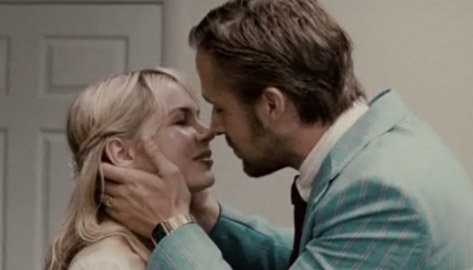
It's official. Blue Valentine is 2010's #2 film. And I really can't tell you about it. I'll say what I can, of course, but its definitely better for film viewers to go in with no idea what the film is truly about, and for that reason the filmmakers should be pleased that the vast majority of people intending to see this only really know this title for the initial NC-17 rating the MPAA gave it before an appeal brought it down to rated R before release. Frankly, it was kind of silly for the film to get such a rating, and this should mean some success for the simply-made indie film, especially with award season underway.

Blue Valentine is the story of a relationship, in this case between Dean (Ryan Gosling), a painter and sometimes-musician, and Cindy (Michelle Williams), a nurse and medical student. The film follows their life as a couple from just before its initial conception to a modern-day crossroads, and portrays it in an unflinching realism that's much darker than most fans of the trailer might expect.

When you have a film with this low a budget, having strong talent in the acting corps is a must. Gosling, who for years now has played critically-acclaimed roles in largely-unheralded films, may have the role of his life thus far as Dean, a high-school drop-out cursed with "limitless potential" who would rather dedicate his life to his relationship with Cindy than anything else. Gosling approaches the role with an array of talents, including deft subtlety, inescapable charm and an amazing persona that at times soothes the spirit and at other times repulses greatly. I can't go into more detail; you'll understand if you see it. Williams likewise may have her biggest role to date, bigger than Jen Lindley or Alma Beers. As Cindy, she has to undergo emotional transformation that goes from happiest she's ever been to distraught in the range of a scene or two and never once is she unbelievable in doing so. What is even better than their individual performances is how well they work as a couple, their chemistry is so that together they make possibly the most believable film couple of 2010, surpassing many comprised of far more established actors.

As for the "ratings controversy" that probably would have derailed Blue Valentine's chances at commercial success, I can say with certainty that the filmmakers were right to appeal for a lesser rating than the initial NC-17. Though there were many objectionable items throughout the film, the rating was mainly given for one emotionally-charges sex scene at the film's midway point. Frankly, though what actually happens is not something you see in cinema nowadays, it's not pornographic and hardly offensive enough to warrant that kind of rating. Rated R is a much more appropriate and allows the film to actually garner an audience. Sure, there have been successful NC-17 films, most notably Midnight Cowboy and A Clockwork Orange (when it was still referred to as an "X" rating) but these days it carries a more negative connotation than most producers or distributors want to be associated with.

The excellent directing of Derek Cianfrance shows many scenes shot in one take, and the ability to make an excellent film without a dozen takes per scene makes Blue Valentine feel more authentic as a film and the audience more ingrained in the story of this couple. It has several difficult themes that are uncomfortable to watch for many people yet nevertheless are realistically rendered. That the film is so real, so uncomfortable while never allowing me to draw my eyes from the screen is the reason I rate it so highly. 2010 has gotten a rap as being a poor year for films, and while that might be true for the blockbuster giants, it's indubitably allowed the independent films to take over, with films like Blue Valentine getting the big chances they might not have had otherwise. Reward them for that chance.

Friday, January 7, 2011

I Hate You Jim Carrey: And Other Reasons I Didn't Want to See this Movie

It's true. It's all true.

Okay, maybe HATE is too strong a word. More accurately you might say that I never GOT why people so adamantly loved Jim Carrey, this overly-goofy comedian whose career has surprisingly not been derailed by several missteps over the course of his now thirty years of acting. What I hated the worst about seeing him in anything was that he COULD be funny, and then go completely over the top in a way that I thought ruined the joke. Fortunately for him, many people disagree, and while he's far from the box office draw he was back in the nineties, he's still one of the hardest working comedians in Hollywood, and while I may not be his biggest fan, I have to at least respect what he's done and the awards he's been recognized with. But that doesn't mean I want to go out of my way to see one of his films, either.

Who knew Rodrigo Santoro had a side job as "The Situation"?
So you can imagine my surprise when, this past Wednesday, I was checking out film times online and was disturbed to find that there was not ONE film available that I had not either seen or had more than a tiny interest in. Blue Valentine was at the top of my list, but hadn't come to town yet. Country Strong wasn't coming out until the weekend. And what the heck is Fei Cheng Wu Rao II, anyway? So it was with some trepidation that I decided to see what my friend Dan (he of the Southland Tales recommendation) had been calling his favorite film of 2010, I Love You Phillip Morris. Starring Jim Carrey.

As The Wire teaches us, there are only two days in prison: The day you go in, and the day you come out
Carrey plays real-life conman Steven Jay Russell, notorious for his uncanny ability to escape prisons. Over the course of the film, Steven becomes a conman to fund his excessive lifestyle, gets sent to prison for the whole conman "thing", enters a homosexual relationship with the Ewan McGregor as the titular Phillip Morris, then tries to build a relationship with Morris outside of prison walls, only to fall back on old habits. In all this Steven is portrayed as both a shrewd and conniving con artist and prison escapist and as a man who would do anything for the people in his life who he cares for.

"Ah wish ah knew how ta quit yoo"
What's surprising about this film is that while it could have easily traipsed down that road into silliness for the sake of silliness, I Love You Phillip Morris displays a good amount of heart, even if that heart is seemingly displayed most often by the film's criminal lead. In fact, many of the crimes Stephen commits over the course of the film are supposedly blamed on his need to fund luxurious lifestyles for he and his lovers, especially Morris. Sure, there's plenty of crude gay sex jokes - enough to perhaps make a whole second film - but thankfully they don't make the whole movie. While a few scenes go a bit to far in an attempt to be serious and tear-jerking, the film's excellent humor manages to remain valid throughout the story's arc and manages to keep even the more reserved viewers entertained. Also, this film might be the first film in recent memory that actually effectively uses voice over dialogue to enhance the story. Usually, when a film gets a voice-over, its because the story is so weak that you need guidance to move the film forward. Here, it's more of a friendly muse that takes the journey with you.

Flowers? How gauche!
The acting was actually quite good, despite this being a Carrey vehicle. Okay, to be honest, Jim Carrey wasn't at all bad here. His Stephen Russell is immensely likable, somewhat inspiring and laughably goofy, a mix that would usually result in confusion and shrugged shoulders, but actually works out fairly well here. As I mentioned before, Carrey was provided excellent dialogue and jokes, but only he had the timing to make it all consistently humorous and entertaining. That I could even walk away from the theater uncertain how to feel about a multiple-convicted felon speaks volumes to his performance. While I thought he still exhibited a bit of over-the-topness that detracted slightly from the film's delivery, it wasn't enough to say I didn't like him here. But I actually thought he was overshadowed by a very good McGregor, who plays the effeminate and light-hearted Phillip Morris. Owning the role, the worst thing I can say about McGregor is that despite having his name in the title, he was far too small a presence in the actual film, so dominated by Carrey is the plot. Former Lost refugee Rodrigo Santoro does a decent job as Jimmy, a former flame of Stephen's. He's not given much, but occasionally is given a chance to shine. Better off is Leslie Mann as Stephen's former wife an the mother of his child. She's really only given much to do in the beginning, but she remains a presence throughout the film and I really liked what they did with the character, even if it might not have been very realistic overall.

Fantasizing about a human centipede...
The film does suffer a few flaws. Some things are a bit unrealistic, but this is not surprising as in most "based on true story" films there are often exaggerations made to make the story more entertaining. The film seems to want to be serious at odd times, and some of the more serious scenes feel out of place in such a comedic film. And one of the film's final lines, stating Stephen Jay Russell was an embarrassment to the state of Texas "and Governor George Bush" seems like an obvious ploy to make him more likable in the eyes of the more liberal viewers who are most likely to be watching this movie. Finally, I thought the gay themes were a bit cliche, with stereotypical performances in the gay roles not deviating from what one might expect from them (note that I don't say they are inaccurate, simply stereotypical).

Yes, it's Carrey and McGregor... for 93 minutes
In the end, it doesn't matter what I think about I Love You Phillip Morris, or for that matter what anyone else thinks. The film had trouble finding distributors in the US for more than a year and has struggled mightily in limited release capacity where it has shown. A forthcoming plan to expand the number of theaters showing the film seems like a risk at best and foolhardy at worst. But it does have one big thing going for it: It's already turned a profit playing overseas. Releasing in Europe, Japan and Taiwan early in 2010, the film has already grossed $18 million, much more than it's purported $13 million budget. So you see? No matter whether I like it or not, anything they do now is simply money in the bank. That said, I did thoroughly enjoy this film, even if I thought it was nowhere near the top of my 2010 movies. If you don't feel comfortable with a title that so flagrantly lets its pride flag stand at attention, you won't like this film. Period. But everyone else should get a chuckle at this film's humor and charming personality, as it may go down as one of 2010's most underrated titles.

Wednesday, January 5, 2011

Hole in One

When all is said and done, 2010 might be remembered as the year of the indie film. Seriously, in a year when so many big productions have scampered to catch every dollar they can just to break even, the indie films are raking in the dough. Winter's Bone, Black Swan, The King's Speech, 127 Hours, and Blue Valentine have all earned their share of positive critical reviews, award nominations and relative box office success even in limited releases. In fact The King's Speech, in earning over $88,000 per theater its opening weekend, had the highest gross per theater for any opening film this year, surpassing another art house winner, The Kids are All Right. But it's not just the financial successes that are worth watching: if we followed that logic, I would be running out to see Little Fockers (hint: I'm not). Sometimes it's the award nominations that direct us to something we might not have given a chance to otherwise. In this way nominations play a huge role in guiding audiences to films they might not otherwise see to drive up box office numbers and make their small film more impressive in the eyes of voters. And damned if it doesn't work. How many films have you not at first seen, only to change your mind when it gets nominated for an Academy Award? Me too, and that's why this past week I took advantage of living near a multiplex that happens to carry the occasional limited release film to see the John Cameron Mitchell-directed Rabbit Hole.

"Hello, I'm Harvey Dent and I want to be your D.A."
Based on the stage play by David Lindsay-Abaire, Rabbit Hole is about grief and mourning. It's been eight months since the death of Becca (Nicole Kidman) and Howie (Aaron Eckhart)'s young son Danny, who was killed in an accident, and the husband and wife still have a hard time reconciling the sudden loss in their life. Visits to support groups don't work for Becca, who is bothered by those who try to justify their child's death by saying that it's God's plan. Stricken by grief, she wants to rid herself of the visual reminders of her lost child, wanting to go so far as to move out of the house they love. This puts her at odds with Howie, who relishes those same reminders and doesn't want to lose the image of Danny from his mind. As the two strain dangerously apart, each makes difficult decisions and try to learn to live with the emptiness that has come in their son's absence.

Yes, there is indeed Al Green playing in the background
Rabbit Hole received a Golden Globe nomination for Best Actress for this film, and when you watch Kidman's performance you'll understand why. Kidman doesn't just cry throughout the film (though she does her fair share) like you might expect in films like this. She shows several sides of grief in her performance, from sadness to depression to disbelief in others' attempts to help her cope. Everywhere she looks and everyone she meets in the course of the film remind her in some way of Danny, and Kidman does an amazing job showing even the tiniest traces of the strain that such things would put on her emotions. She does the big waterworks productions to excellent effect as well, but it's the restraint in her performance that really sticks out and makes it a must-see.

For God sakes, woman, don't let him get on the topic of shrimp!
Compared to Kidman, everyone else in the film doesn't quite stack up, but closest is Eckhart as the suffering husband Howie. Unlike Becca, Howie doesn't want to let go of Danny's memory, wants the help of others both familial and stranger, and regularly immerses himself in the memories of raising his son. Like Kidman, Eckhart doesn't just mourn in one way, and he varies from subtle to loud in his work. It's only because of Kidman's stellar performance that one could say he was lacking, and he does a fine job in his understated execution. Award-winning actress Diane Weist does an amazing job playing Becca's mother Nat, who underwent a similar process with Becca's deceased brother years ago. Weist is a great storyteller and her appearances in the film, though sometimes straining, always serve a purpose to push the movie's tale forward. Other great showings come from Sandra Oh as a member of the support group Becca and Howie attend, Tammy Blanchard as Becca's insufferable and immature sister Izzy, and Miles Teller as Jason, a teen who Becca befriends over the course of the film.

Life feeling like a Prozac commercial?
Of course, there's no guarantee even award-addled audiences will want to see a film in which the main plot device is the death of a child. It's particularly dark stuff, full of bittersweet memories and encounters, and the great performances by the leads means you the audience feels the same grief they do, albeit on a much smaller scale. The film is also a bit predictable, as you can guess some events before their occurrence and the characters take a few side-trips in their emotional roller-coaster journeys that are telegraphed a mile away, though their impact on the audience is still palpable enough as to be moving. Some off-beat pacing slows down the film at parts as well, but not poorly enough to detract from the tale telling.

The weirdest hand-holding scene EVER
For what it's worth, Rabbit Hole may not be a perfect film but is still a very comendable one. Even with the amazing performances by its star cast, it however has the risk of being completely overshadowed by even the other indie films this year, not just the big blockbusters. 2010 was a big year for working small, and I hope that Kidman's performance doesn't completely get shut out by the Portmans, Hathaways and Jolies that threaten to take over during this biggest of movie seasons. I would put this one in the same category as Winter's Bone, a sterling and emotional ride that may not leave you wholly fulfilled, but definitely makes you think about life and it's many existential mysteries.

Tuesday, January 4, 2011

A Bard's Tale

I was first introduced to Shakespeare in the seventh grade. Well, that not be entirely true. Even by that point I was aware of the enormous impact the writer had made upon not only the the literary world, but the English language as a whole. But for all intents and purposes I first read his work while at school here in Boston, and to some extent I took to it right away. The Bard is not exactly 'light reading', and many passages might have been all but unreadable to someone my age without the teacher able to explain certain convoluted passages. Shakespeare wasn't meant to be simply read: he was a playwright whose true popularity didn't come until long after his death, and the books we read growing up were always meant to be seen on stage, in performance, and there have also been numerous film adaptations of his works directed by the likes of Kenneth Branagh, Peter Hall, and Baz Luhrmann. So with this latest adaptation by stage and screen director Julia Taymor (that I saw last week alongside my friend The Opinioness) it is funny that the title is both the first of Shakespeare's plays to which I was introduced while also considered the last of the plays that he alone wrote.

See how moody we can make this?
The Tempest begins with exactly that, as the sorceress Prospera (Helen Mirren) summons a storm to sink a ship with the King of Naples Alonzo (David Strathairn) and his subjects aboard and wash them ashore. There, she plans to extract her revenge for being usurped by her brother Antonio (Chris Cooper) when he accused her of using witchcraft to kill her husband, the Duke of Milan. Having been stranded on an enchanted isle for the past 12 years, Prospera has raised her daughter (Felicity Jones) alone, with only the slave Caliban (Djimon Hounsou) and the mischievous spirit Ariel (Ben Whishaw) as company, Prospera is taking this opportunity of all her enemies being  in one place to teach them a lesson they won't soon forget.

Caliban is what they would call a "happy drunk"
While the language doesn't always survive intact, this IS still Shakespeare. That means that there are constantly more words than necessarily needed to describe a scene we can already can see with perfect clarity. Of course, Shakespeare HAD to overly describe the scenes for the audience since his performers were usually on stages devoid of all visual descriptors. While some passages and lines are cut, the presence of his words remain and in a way Shakespeare is the film's main character, as he's always at the forefront of the story; Even while watching you often overlook the acting of Mirren or the direction of Taymor and think, "This is Shakespeare," so obvious is his verbiage.

How utterly unimpressive
Sadly, this is one of the film's main faults. Despite the performers' best efforts, they are often overshadowed by the words they are speaking, when they're not being overshadowed by flies buzzing in the background. I'll see Mirren in just about anything. Possessing a powerful voice, she can make just about anything interesting, and she had the best performance in this cast. The problem is her character. Prospera (adapted from the Duke Prospero in the original Shakespeare) has a revenge plan for those that wronged her, but she doesn't seem much more sympathetic than any of the other characters, even the undoubtedly bad guys like Antonio or Caliban. Taymor tries to imply a bit of feminism in the role by indicating that she was banished because she was a woman, but it doesn't come off as legitimate here, and there's really not much difference between her and the original Prospero. At least she's better than Felicity Jones, who plays daughter Miranda, and Reeve Carney, who plays Alonzo's son Ferdinand. Both are cringe-worthy actors, and when Ferdinand sings a Shakespeare poem as a love song to Miranda, we want to cover our ears because he CAN'T SING, which is hilarious since Carney is currently the lead on Taymor's stillborn stage show Spider-Man: Turn off the Dark. Perhaps it's just not his singing style on display here, but his scenes with Jones are boring and trite, reveling in the worst of Shakespeare's literary work.

Prepare to be bored to tears by Jones
The rest of the cast are mostly hard-working actors and many of them have done Shakespeare before, though some were odd selections to say the least. Djimon Hounsou is fairly powerful as the angry slave Caliban, but the truth is that he could have probably played just about any character in the film better than it's existing occupant, possibly including Mirren. So why does the film's only black actor play the trod-upon slave? I'll let that one hang, though the way his character is treated does speak volumes to issues of colonialism and slavery, as pointed out in a review by The Opinioness here. David Strathairn is an actor I love, but he seems to be mailing it in as King Alonzo. In truth, he doesn't have much to work with (I don't remember if that was the same in the play) but his performance seems surprisingly uninspired for an actor of his caliber. Tom Conti is great as the the noble Gonzalo, and Alan Cumming is well cast is not necessarily the best for the role of the King's ambitious brother Sebastian. Alfred Molina is hilarious as the drunkard Stephano (who was one of my favorites when I first read the play) and appears in some of the film's best (and, sadly, worst) scenes. Ben Whishaw plays the spirit Ariel to good effect, though I had issues with thew character that I'll get into later.

The setting and language are beautiful... Everything else, not so much
The two characters oddly cast were those of Prospera's brother Antonio and the jester Trinculo. Chris Cooper seems more at home playing modern-day blue collar characters, but he surprising comes off as effective as Prospera's loathsome brother. He's not the best, though this might be due to poor direction rather than his acting abilities. But the other odd casting choice was that of comedian Russell Brand as Trinculo. Though Brand might at first seem the right type to play the fool, he can't escape the fact that this is a work Shakespeare, and his line deliveries are often too whimsical or too often place heavy emphasis on certain words that sometimes comes with inexperienced actors tackling works like these. Brand is on occasion funny, but too often the best he could illicit from me was a  raised eyebrow and a question of when the scene would be over.

Thankfully not shown: Ariel's man-boobs
It's obvious the $20 million spent on the film's budget wasn't for special effects. Though filming around the volcanic areas of Hawaii provided scenery as beautiful as anything you've seen before, the few scenes were digital effects are used look horrid and detract from the film's natural elegance. Scenes especially with Ariel flying around at his mistress' bidding look ugly, and a recounting of him causing the tempest to sink the ship looks overly-stylized, And let's not forget his distracting man-boobs, which like a highway pileup I couldn't draw my eyes from no matter how hard I tried. The film then apparently ran out of money, as there are many more scenes that might have benefited from a digital make-over but come off more as stage tricks than cinema magic, especially towards the film's conclusion. Speaking of the film's conclusion, while I was glad to see it come I was startled by how swiftly it came, as while Taymor seems to anticipate that Shakespeare buffs appreciate the film's final act, it comes off as merely swift and a "well, that's done" attitude before the final credits.

Ah, the old "ring of fire" routine, an old favorite
Despite some interesting bits, I found myself epically bored by this version of The Tempest. I'm not sure how this happened, as you can't simply say that Taymor didn't understand what she was doing with the Bard's work. After all, she's directed Shakespeare on stage and screen before, most notably with Titus in 1999. Though her films have usually gotten mixed reviews in the past, boring is the one thing they've never before been described as. It's not too often that you can get a cast together with this much talent and fail miserably, but kudos to Taymor for doing it in style. Now Spider-Man: Turn off the Dark won't her only missed shot of 2010.

Friday, December 31, 2010

Happy 2011! The Worst Films of 2010

So here we are. 2010 comes to a close, 2011 is around the corner and, as always, there will be more films to see. Most hail from Hollywood, CA, but hundreds of films are also released globally every year, and damned if I won't be seeing at least some of them. 2011 promises to get a more comprehensive look from The Latest Issue, certainly more than 2010, when I basically started in May and was playing catch-up all year. I don't know how long it will take me to see everything I wanted from 2010, but 2011 promises to bring much more to the site, and I'm glad to say I'm ready for it. Big changes are on the horizon, and I wouldn't be here without the support of readers like yourself, or the random Google clicks that brings the rest of you to the site. As many of you already know, I already have a running tally of my Top 10 Films from 2010, based obviously on what I've watched this year. I like to think it's a fairly varied list, representative of the different styles of film I've enjoyed this year, but today I'm doing something different. Today I'm presenting to you (in my opinion) the worst films of 2010. With luck, you haven't seen any of these atrocities, but if you did at least you can live with the comfort that you weren't the only one who saw it and thought it was donkey dung. So without further ado, let's get this show started.


10) Machete
What makes a great short piece does not necessarily make a great film. The original trailer for Machete was a gag shown during Grindhouse back in 2007, but director Robert Rodriguez obviously thought he had a big deal on his hands, because he copy-pasted the silly story into a full-length piece of schlock. Hiring just about every actor in Hollywood with a bit of Latin in their veins, low-lights included Jessica Alba lamely inciting Mexican rebellion and hero Machete's anticlimactic battle with... Steven Seagal? Enjoyable if you shut off all outward sensory nodes, but what might have seemed like vintage exploitation film to the filmmakers comes off as pure crap stuck together with play-doh.


9) Iron Man 2
How do you follow up the surprising and innovative superhero action film that suddenly thrust Marvel Comics films into relevance? If you're director (and occasional actor) Jon Favreau, you take everything that made the original film so cool and throw it out the window of a Concord jet crossing the Atlantic, thereby ensuring it can never be recovered. Even getting past the unjustified firing of Terrence Howard and replacing the role of James "War Machine" Rhodes with Don Cheadle, the film simply lacks even the remotest amount of excitement that made the first so much fun to watch. Scarlett Johansson is completely miscast as Russian agent Natasha Romanoff (though she does have the best scene in the entire film) and Mickey Rourke played a bad guy that was so silly it was difficult to take him seriously. Hopes are high for forthcoming sequels and the Avengers movie, but this one failed to live up to even moderate expectations.

  
8) Hereafter
Clint Eastwood WOULD make the idea of what lies beyond the end of life dull beyond words. Despite an intriguing concept, Eastwood's latest effort reeks of formulaic storytelling, missed opportunities and characters we don't particularly care about, and for what reason I still can't fathom. Is he trying to get people to talk about the afterlife? Something people don't want to think about? Either way, wasted are performances by Matt Damon, Cecile de France and Bryce Dallas Howard on a script where no answers are really offered, and the whole thing reeks of an advertisement for New Age beliefs and practices.


7) The Tempest
I'll get more into this one on Monday, but here's the skinny: I'll normally watch Helen Mirren in anything, but this bloated retread of Shakespeare by director Julie Taymor is flat out boring, something the Bard should NEVER be in performance. Vacillating between low-tech theatrics and big-budget charlatanism, the film takes some big risks in casting and while some work out better than planned (Chris Cooper), others beg for forgiveness (Russell Brand). Also: Ariel's (Ben Whishaw) man-boobs. Disturbing.

  
6) The Warrior's Way
Hey, you got your Cowboy Western in my East Asian Fantasy! You got your East Asian Fantasy into my Cowboy Western! Wow, the two together taste like shit! Ninjas invade a small wild west town and not even strong performances by Geoffrey Rush and Jang Dong-gun and a cute baby can save them. Kate Bosworth should have been nominated for a Razzie, but I guess not enough people saw this film to give a damn to do even that. Worst: The best line in the trailer, Rush's "Ninja's, Damn," doesn't make an appearance once throughout the film's 100 minutes. Epic fail.


5) Prince of Persia: The Sands of Time
From Jerry Bruckheimer, the maker of films like the horrid Pirates of the Caribbean sequels and G-Force, comes possibly the worst video game to movie adaptation since Doom. He must have asked Uwe Boll for assistance, because while the games for Prince of Persia are amazing experiences, the transformation reveals a film that would have needed more time polishing the special effects just to reach "mediocre" status. Besides the fact that American actor Jake Gyllenhaal should never have been cast as a Persian monarch under even the best of circumstances, any film hiring Ben Kingsley at this point in his career is just screaming that it could do better. That it was successful makes it even worse, since in 2012 it will be getting it's own sequel that you know will probably be on this list as well.


4) Repo Men
A futuristic sci-fi warning about the inherent dangers of Big Business? Based on a book that nobody cares about? With a lead actor, Jude Law, that I don't care for? I'm surprised that Repo Men didn't score higher on the list, but the film would have been worse without the almost criminal amounts of bloodletting that wrap around a plot that goes from zero to "meh" in what feels like four hours but in reality comes in under two. It should have been better with actors like Forest Whitaker, Alice Braga, Liev Schrieber and Carice van Houten, but the scripts does them no favors, lending entirely too much to Law's voice-overs and requiring a suspension of belief from it's audience that is far too unreasonable. One of the worst movies nobody saw this year.


3) Jonah Hex
Two words: Megan Fox. Okay, it would be unfair to put all the blame for the crime against nature that was Jonah Hex on her pretty little head, but the talent-less she-devil sure didn't help matters. A god-awful script by the duo Neveldine/Taylor didn't help, nor stars Josh Brolin or John Malkovich, who are otherwise good performers. Animator-turned-director Jimmy Hayward simply didn't deserve to be put in charge of this film, and I would find it hilarious if he was put in charge of any production crews in the near future. This title could be considered vintage, if that only meant hearkening back to the days of comic book films automatically being so bad that even fans of the comic hesitated showing their heads. And did I mention an awful acting job by Megan Fox?


2) Skyline
I should have known better. I was warned. I even went in with low expectations hoping to be surprised. Wow, was I wrong. Despite the film's amazing visual effects, the film's scope was so small as to be restrictive to possible story arcs, and not a single character was even remotely likable. The result is a film that had so much potential boiling down to a stupid film starring Eric Balfour, which is what we should have noticed in the first place. I'd rather take next year's Battle L.A., since it seems from previews to be everything Skyline wasn't.


1) Legion
What hurts the most is that this film actually made money. I admit to thinking the theatrical trailer actually looked good when I saw it late last year, but the finished product was ugly, derivative, poorly acted and just generally unclean. I'm sorry, but the idea of God waging war on Earth for its transgressions and an angel played by Paul Bettany rebelling to save the last hope of humanity just SOUNDS too cool to mess up. This film is by far the number one reason I can't get excited for next year's Priest, thanks to the unholy link that is director Scott Stewart. And it was by FAR the worst film of 2010. Nobody else even came close.

I hope you enjoyed this special edition of The Latest Issue! We're washing our hands of 2010's mistakes and hoping for a new, brighter tomorrow, complete with a new month, a new year, and new films worth reviewing.

Happy New Year, and I'll see you in the future.

Wednesday, December 29, 2010

Over the Rainbow

There's no doubt out there that Sofia Coppola is a talented filmmaker. 2003's Lost in Translation, her award-winning second feature film, is a modern classic and exhibited flawless performances by it's leads, Bill Murray and Scarlet Johansson. It spoke of loneliness, alienation and general ennui, all while in a dramatically different land. It was a haunting film, and one that many artists could have just as easily screwed up than replicated. Coppola's fourth film, Somewhere, has just been released, and seems at first to examine those same themes, while trading the exotic land that is Tokyo for a seemingly much more emotionally remote place: Hollywood.

Scaring Elle with his Christian Slater impersonation
In Somewhere, Stephen Dorff plays... wait, wait a minute. STEPHEN DORFF? Seriously? Wow, congratulations, Stephen! I mean, no offense, but you've NEVER been in such a high-profile film before. I mean, we always KNEW you were an actor, but your films have never been ones that people, you know, watched. I mean, will anyone actually ADMIT to having seen Alone in the Dark, or Shadowboxer, or Space Truckers? That's what I thought. I mean, yeah, I reviewed XIII: The Conspiracy earlier this year, but that was pure chance, not a concerted effort on my part.

Interesting fact (lie): Fanning has in fact been invited to more award shows than Dorff
So anyway, back to what I was saying. In Somewhere, Stephen Dorff plays Hollywood bad boy Johnny Marko, a big-time movie star who lives his life in the lap of luxury, driving around an expensive Ferrari and constantly in the beds of numerous beautiful women. Women want him and men want to be him, and from the outside it would seem he's living every American's fantasy life. On the inside, however, he's extremely dissatisfied and is only truly happy when spending time with his daughter Chloe (Elle Fanning), with whom he has always had a strained relationship due to his work.

...and yet, I can actually more believe Dorff as the big movie star than Monaghan
It's clear from the start that the same themes that moved Lost in Translation forward are ever present in this new film. That loneliness, alienation and boredom is what moves Somewhere's plot as well, but having it take place in Hollywood, where Johnny would seemingly be home, instead of in a strange, faraway land is almost more tragic. It's also reasonable to assume that Coppola took bits from her relationship with her own father, director Francis Ford Coppola, as inspiration for the story. But what's lacking is Translation's ability to pace effectively. We have to sit through several scenes that express excess, boredom, dissatisfaction, loneliness, anxiety and back to excess through dialogue-less, drawn-out scenes in which very little actually happens. While it conveys the film's mood well, it does little to keep the film's story going, while in fact alienating the audience as a result. The story in fact almost seems like a side-note, often over-shadowed by excessive moodiness and feelings of despair.

That reminds me... I need to get the new Rock Band
The acting possibly could have been better, but the focus is almost entirely on the film's leads. Dorff is actually subtle and sensitive as Marko, seeking what little enjoyment he can purchase from his glamorous lifestyle while only truly enjoying the time he spends with his daughter. As strange as the idea may be to feel sorry for a Hollywood big shot, I can actually understand what his character is supposed to be seeking. Marko is stuck on this continual roller coaster of false glimmer and idolization. What he wants is something real, and he rediscovers it when he and Chloe are thrust together unexpectedly. Dorff does this while showing us a side to his persona that we've never seen before. While she's not her sister Dakota talent-wise, Elle Fanning is more than adequate as the attention-starved daughter, Chloe. You can see in her eyes that she loves her father despite all his faults, even while silently disappointed in his bed-hopping ways and his lack of having been around. Fanning is simply a cute kid when she needs to be, but when the time comes to step up, she admirably does the job. Other roles which could have been expanded upon and made more interesting were unfortunately left alone, including those of Laura Chaitti, Michelle Monaghan, Lala Sloatman and Chris Pontius as professional and personal acquaintances of Marko. In practice they are mere window dressing to the duo that is Dorff/Fanning, and while that duo may not have the charm of Murray/Johansson, they come close enough for the audience to be sympathetic towards them.

"So tell me, how are you recovering from your masterbatory injury?"
If Somewhere could survive solely on the performances of its lead actors, it would be the perfect film. Unfortunately, it takes more than great acting to make a top-notch production. I can even overlook some unresolved minor plot points, since this is the type of film in which everything doesn't need excessive tying up of loose threads. With far too many slow patches, a serious lack of secondary players, and an ending that, unlike the rest of the film, is completely devoid of grace and subtlety, I honestly can't say that Somewhere impressed me as a feature film more than it's trailer had. Even the soundtrack headlined by the amazing band Phoenix can't raise the title completely from the doldrums of mediocrity. It may seem unfair to endlessly compare Somewhere to Coppola's earlier masterpiece, but to be blunt she put so many of the elements in that made that possible in the first place. And this film, as good as it is in parts, is no Translation. See it for the strong performances, but not much else.

Somewhere will put your kids to sleep. There, that's the tag line